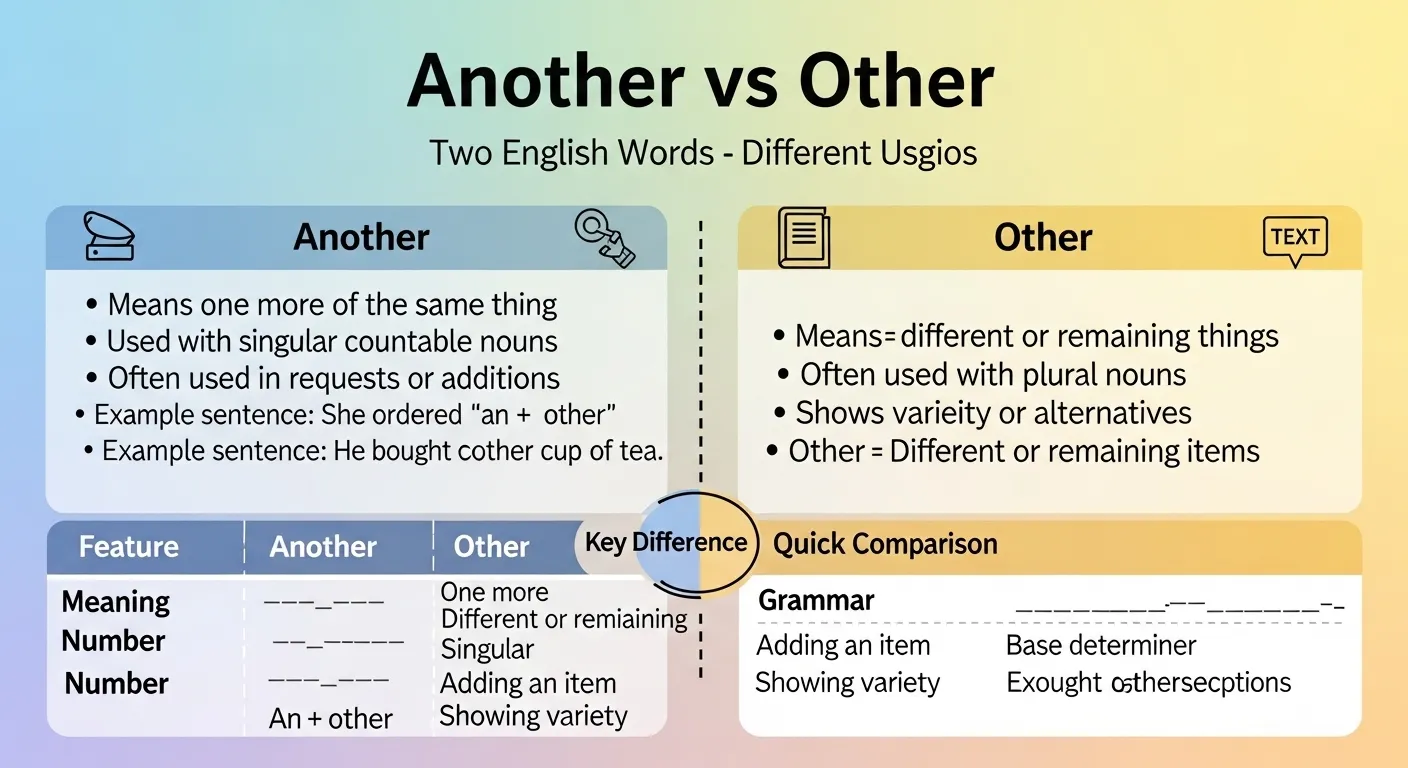
The difference between another and other is simple. Another refers to one more or an additional item, while other refers to different or remaining items. Imagine a customer buying apples in a market.
The seller gives him one apple, and the customer asks for another apple. This means he wants one more apple of the same kind.
Later the customer notices bananas and oranges and asks about other fruits available in the shop. This situation explains the difference between another or other in daily language.
Many learners search questions like “another vs other examples,” “when to use another and other,” and “difference between another other and others.”
These searches show that the difference between another vs other is an important part of English grammar.
Both words are common in everyday communication, yet their usage changes depending on number and context.
Understanding the difference between other and another helps learners write and speak English more accurately.
Key Difference Between the Both
The main difference is number and reference. Another refers to one additional item, while other refers to different or remaining items in general.
Why Their Difference Is Necessary for Learners and Experts
Knowing this difference improves grammatical accuracy. Students use these words frequently in writing and speaking.
Teachers and writers rely on them to describe quantity and comparison clearly. In daily conversations people also use them to ask for extra items or refer to different things.
Understanding their correct use prevents confusion and helps speakers express ideas clearly in academic, professional, and everyday contexts.
Pronunciation (US & UK)
| Term | US Pronunciation | UK Pronunciation |
| Another | /əˈnʌðər/ | /əˈnʌðə/ |
| Other | /ˈʌðər/ | /ˈʌðə/ |
Now that the basic idea is clear, the next section explains the detailed difference between another and other.
Difference Between the Keywords
1. Meaning
Another means one more of the same kind. Other means different or additional items.
Example 1:
She ordered another cup of tea.
Example 2:
He bought other books from the store.
2. Number Reference
Another refers to a single item. Other can refer to plural items.
Example 1:
I need another pen.
Example 2:
She invited other friends to the party.
3. Use with Countable Nouns
Another is used with singular countable nouns. Other is often used with plural nouns.
Example 1:
He tried another solution.
Example 2:
They discussed other ideas.
4. Position in a Sentence
Another usually comes before a singular noun. Other can appear before plural nouns or with determiners.
Example 1:
She wants another chance.
Example 2:
Other students agreed with the plan.
5. Use in Requests
Another is common in requests for additional items.
Example 1:
May I have another glass of water?
Example 2:
Do you have other options?
6. Expression of Difference
Other highlights difference or variety.
Example 1:
He bought another ticket for the show.
Example 2:
They visited other cities during the trip.
7. Grammar Structure
Another combines “an” and “other.” Other remains a separate determiner.
Example 1:
She asked for another opportunity.
Example 2:
Other opportunities may appear later.
8. Use with Pronouns
Other can combine with pronouns such as others or the others.
Example 1:
He chose another route.
Example 2:
Some students left while others stayed.
9. Context of Use
Another is used when the quantity increases by one. Other refers to different items in general.
Example 1:
She bought another notebook.
Example 2:
He looked at other notebooks.
10. Tone in Communication
Another often suggests continuation. Other suggests comparison or difference.
Example 1:
He asked another question.
Example 2:
They explored other possibilities.
Nature and Behaviour
Nature of Another
Another focuses on adding one more item. It often appears in requests, offers, and repeated actions.
Nature of Other
Other focuses on difference or remaining items. It appears frequently in comparisons and descriptions.
Why People Are Confused About Their Use
Both words come from the same root word “other.” Their meanings also overlap in some contexts. Because of this similarity, learners often mix them in sentences.
Table Showing Difference and Similarity
| Feature | Another | Other | Similarity |
| Meaning | One more | Different or remaining | Both refer to additional things |
| Number | Singular | Often plural | Both modify nouns |
| Usage | Extra item | Variety or difference | Both common in English |
| Grammar | An + other | Base word | Both function as determiners |
| Context | Addition | Comparison | Both describe quantity or variation |
Which Is Better in What Situation
When Another Is Better
Another is better when someone wants one more item or opportunity. It is commonly used in requests and offers. For example, in restaurants people may ask for another cup of tea or another slice of cake.
When Other Is Better
Other is better when referring to different items or alternatives. It is useful when describing variety or comparing options. For example, a student may explore other subjects or other career opportunities.
How the Keywords Are Used in Metaphors and Similes
Another metaphor:
Example: “Every challenge gives another door to success.”
Other metaphor:
Example: “Opportunities appear like other paths in a forest.”
Connotative Meaning
Another – positive tone
Example: “She received another chance to prove her ability.”
Other – neutral tone
Example: “He considered other possibilities before deciding.”
Idioms or Proverbs Related to the Words
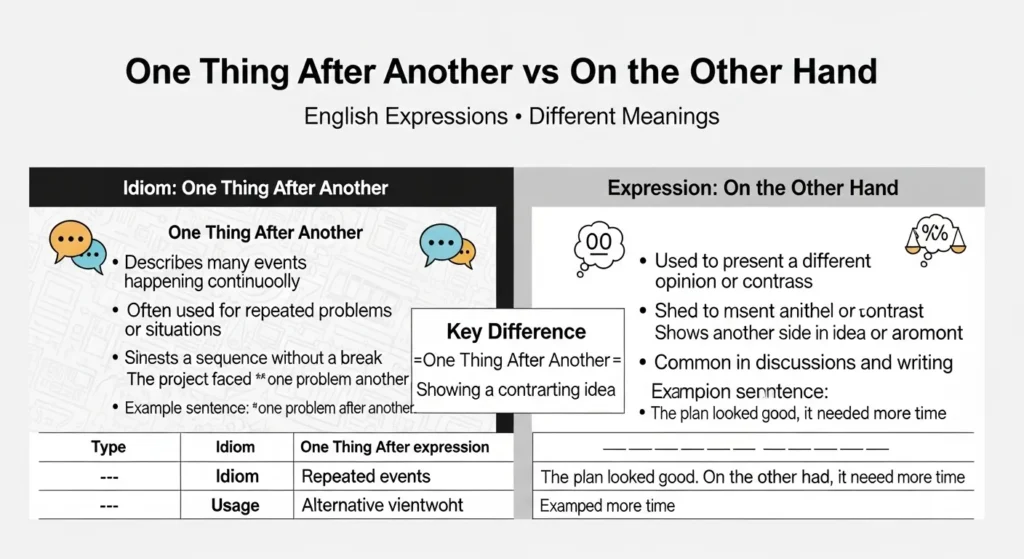
One thing after another
Example: The project faced one problem after another.
On the other hand
Example: The plan looked good. On the other hand, it needed more time.
Works in Literature
- The Other Side of Silence Historical Writing, Philip Kerr, 2016
- The Other Boleyn Girl Historical Fiction, Philippa Gregory, 2001
- Another Country Novel, James Baldwin, 1962
Movies Related to the Keywords
- Another Earth 2011, United States
- The Others 2001, Spain/United States
- Another Round 2020, Denmark
Frequently Asked Questions
1. What is the main difference between another and other?
Another refers to one more item, while other refers to different or remaining items.
2. Can another be used with plural nouns?
No. Another usually comes with singular nouns.
3. Is other used with singular nouns?
Yes. It can appear with singular nouns when determiners are present.
4. What is the difference between other and others?
Other modifies a noun, while others replaces the noun.
5. Why do learners confuse another and other?
Because both words share a similar root and meaning.
How Both Are Useful for Surroundings
Both words help people describe quantity, variety, and comparison in communication. They allow speakers to request additional items, mention alternatives, and express different possibilities.
Final Words for the Both
Another and other are simple yet powerful words in English grammar. Understanding their difference helps speakers express ideas clearly and accurately.
Conclusion
The difference between another and other mainly involves number and context. Another refers to one additional item, while other refers to different or remaining items. Both words play important roles in everyday communication, writing, and learning.
When learners understand the difference between another and other, they can form clearer sentences and avoid grammatical mistakes. Mastering their usage improves both spoken and written English.
Discover More Articals!
Difference Between Renounce and Denounce
🏍️ Difference Between R1 and R1M
Key Difference Between Listen and Hear(2026)

labdiff.com is my English grammar comparison website where I simplify confusing words, spelling differences, and usage rules through clear explanations and examples. My goal is to help learners, writers, and students understand English easily and use correct grammar with confidence.