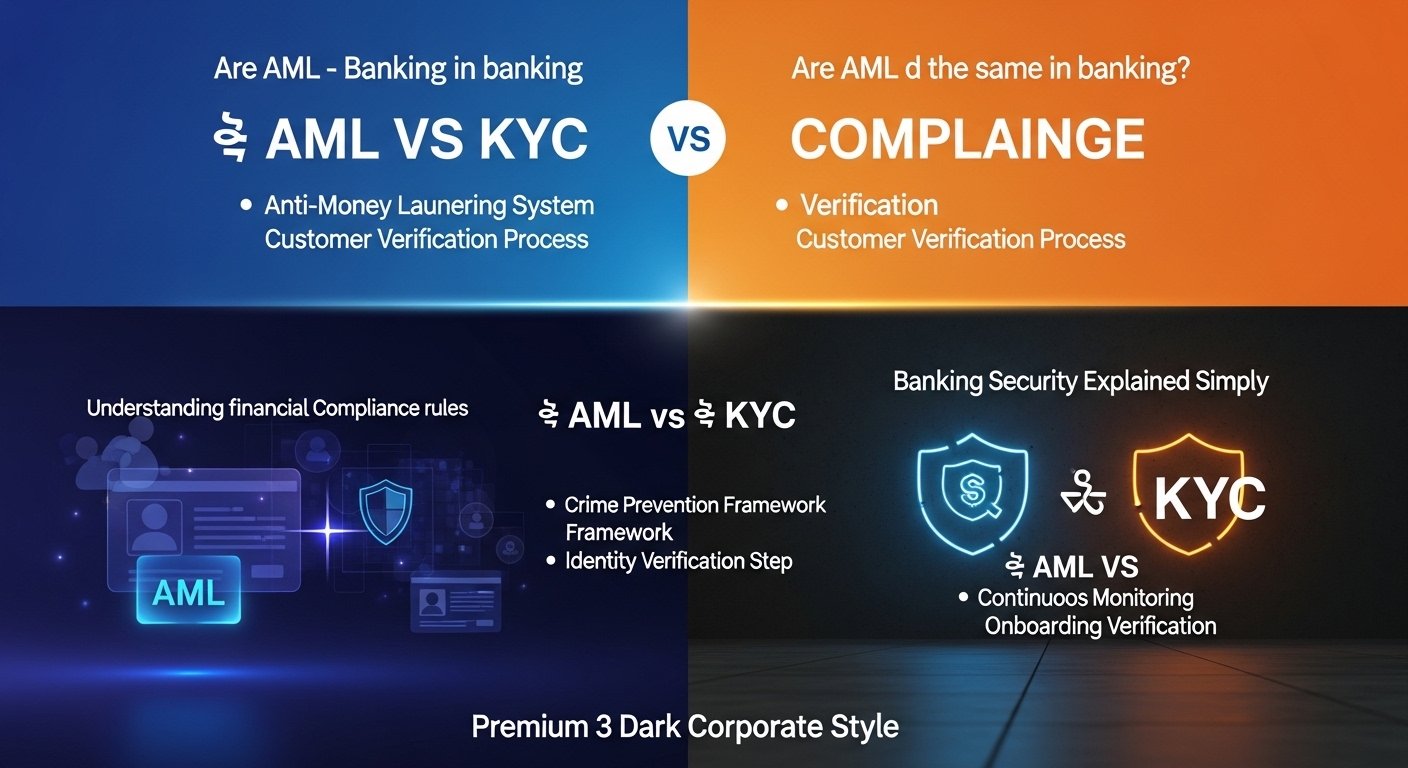
AML (Anti Money Laundering) refers to laws and processes to prevent illegal money activities, while KYC (Know Your Customer) is the process of verifying a customer’s identity as part of AML compliance.
When I first studied banking rules, I heard AML vs KYC. Both terms are common in banks. Both are related to financial security. But there is a clear difference between AML and KYC.
The difference between AML and KYC is mainly about purpose and scope. AML is a broad system to prevent money laundering.
KYC is a process to verify customer identity. Many people think they are the same. But they are connected, not identical.
Understanding the difference between AML or KYC helps in banking, finance, and compliance careers.
Once you know the difference between AML and KYC, financial regulations become easier to understand.
🔑 Key Difference Between the Both
The main difference between AML and KYC is that AML is a complete anti money laundering framework, while KYC is a specific process used within AML to verify customer identity.
🎓 Why Is Their Difference Important?
Knowing the difference between AML and KYC helps bankers. It helps business owners. It also helps customers understand verification processes.
🔊 Pronunciation
🗣️ AML
- US: /ˌeɪ.emˈel/
- UK: /ˌeɪ.emˈel/
🗣️ KYC
- US: /ˌkeɪ.waɪˈsiː/
- UK: /ˌkeɪ.waɪˈsiː/
Now let’s see the detailed differences.
🏦 Difference Between KYC and AML
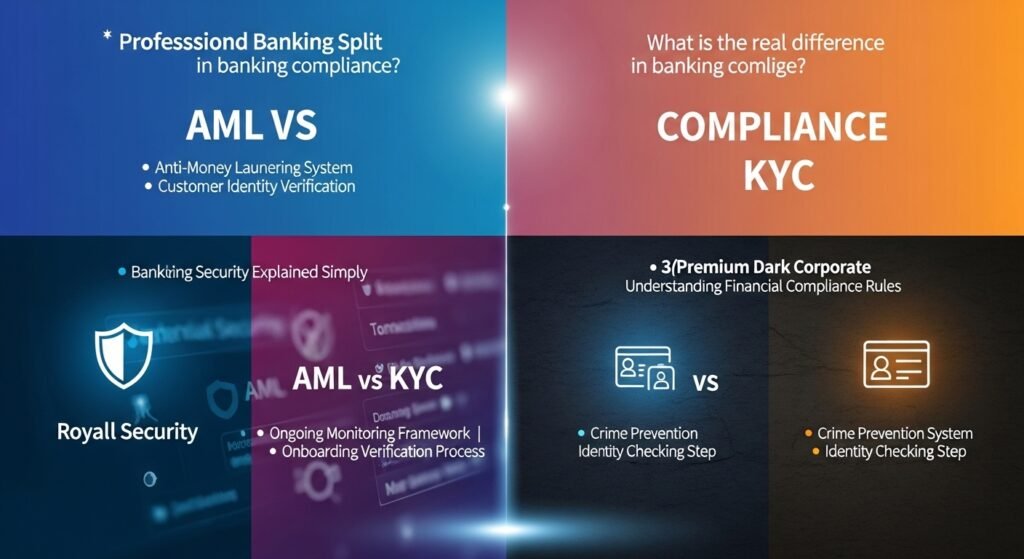
📖 Definition of AML
AML stands for Anti Money Laundering. It is a system of laws and policies to prevent illegal money activities.
📖 Definition of KYC
KYC stands for Know Your Customer. It is a process to verify customer identity before financial transactions.
1️⃣ Scope
AML: Broad concept.
- Covers laws and regulations.
- Includes monitoring and reporting.
KYC: Narrow concept.
- Focuses on identity verification.
- Part of AML framework.
2️⃣ Purpose
AML: Prevent money laundering and terrorism financing.
- Detect suspicious transactions.
- Reduce financial crime.
KYC: Identify customers.
- Confirm identity documents.
- Assess customer risk.
3️⃣ Process Type
AML: Ongoing compliance program.
- Transaction monitoring.
- Suspicious activity reporting.
KYC: Initial and periodic verification.
- ID proof collection.
- Address verification.
4️⃣ Legal Requirement
AML: Required by global regulations.
- Government enforced.
- Strict penalties for violation.
KYC: Mandatory under AML laws.
- Required by banks.
- Applied during account opening.
5️⃣ Risk Assessment
AML: Monitors financial behavior.
- Flags unusual patterns.
- Detects fraud.
KYC: Evaluates customer risk profile.
- High risk customer category.
- Politically exposed persons check.
6️⃣ Timing
AML: Continuous process.
- Ongoing monitoring.
- Regular audits.
KYC: Done at onboarding.
- Updated periodically.
- Triggered by changes.
7️⃣ Reporting
AML: Reports suspicious activities.
- Suspicious Activity Reports (SAR).
- Filed to regulators.
KYC: No direct reporting.
- Internal verification.
- Customer file maintenance.
8️⃣ Technology Use
AML: Uses monitoring software.
- AI based detection systems.
- Transaction screening tools.
KYC: Uses identity verification tools.
- Document scanning.
- Biometric verification.
9️⃣ Examples
AML Example:
- Reporting suspicious transfer to authorities.
- Blocking illegal transactions.
KYC Example:
- Asking passport copy.
- Verifying customer address proof.
🔟 Regulatory Oversight
Financial institutions follow AML laws guided by global standards like the Financial Action Task Force.
- AML follows international guidelines.
- KYC follows AML compliance rules.
🌿 Nature and Behavior
🛡️ AML
Wide protection system.
Prevents illegal money flow.
Continuous monitoring.
📑 KYC
Identity checking process.
Customer verification step.
Initial screening.
🤔 Why Are People Confused?
Both relate to banking security.
Both protect financial system.
KYC is part of AML.
📊 Difference and Similarity Table
| Feature | AML | KYC | Similarity |
| Meaning | Anti money laundering system | Know your customer process | Financial compliance |
| Scope | Broad | Specific | Used in banks |
| Purpose | Prevent illegal money | Verify identity | Reduce risk |
| Timing | Continuous | Onboarding stage | Legal requirement |
| Monitoring | Yes | Limited | Protect system |
🏆 Which Is More Important in What Situation?
🛡️ AML (Best for Financial Security)
Important for preventing crime.
Protects banking system.
Ensures legal compliance.
📑 KYC (Best for Customer Verification)
Important during account opening.
Identifies real customer.
Prevents fake accounts.
❓ FAQs
1. Is KYC part of AML?
Yes.
2. Which is broader?
AML is broader.
3. Is KYC mandatory?
Yes.
4. Does AML include monitoring?
Yes.
5. Why do banks ask for ID?
For KYC verification.
🌍 Usefulness
Both protect financial systems.
Both build trust in banking.
📝 Final Words
AML and KYC are related but different.
One is a system.
One is a process.
📌 Conclusion
The difference between AML and KYC is mainly about scope, function, and purpose. AML, which stands for Anti Money Laundering, is a broad regulatory framework designed to prevent illegal financial activities such as money laundering and terrorist financing.
It includes laws, monitoring systems, reporting requirements, and compliance programs. AML is an ongoing process.
Financial institutions must continuously monitor transactions, identify suspicious activities, and report them to authorities. It protects the entire financial system from misuse and criminal activity.
On the other hand, KYC, which stands for Know Your Customer, is a specific process within the AML framework. It focuses on verifying the identity of customers.
Banks collect identification documents, proof of address, and other personal details during account opening. KYC helps institutions understand who their customers are and assess their risk level.
In simple terms, AML is the complete security system, and KYC is one important step inside that system. Both are legally required. Both are essential for financial safety.
Understanding the difference between AML and KYC helps individuals and businesses comply with regulations and maintain trust in the financial system.
Discover More Posts!
🌸 Difference Between Parfum and Elixir : Complete Guide
🏢 Difference Between Corporation and Company: Simple and Clear Guide

James Whitmore. Labdiff.com is my english grammar comparision website. I explore the history and evolution of English words. I write detailed comparisons explaining why spellings change over time and how British and American English diverged. My articles add depth and credibility to grammar comparison topics.