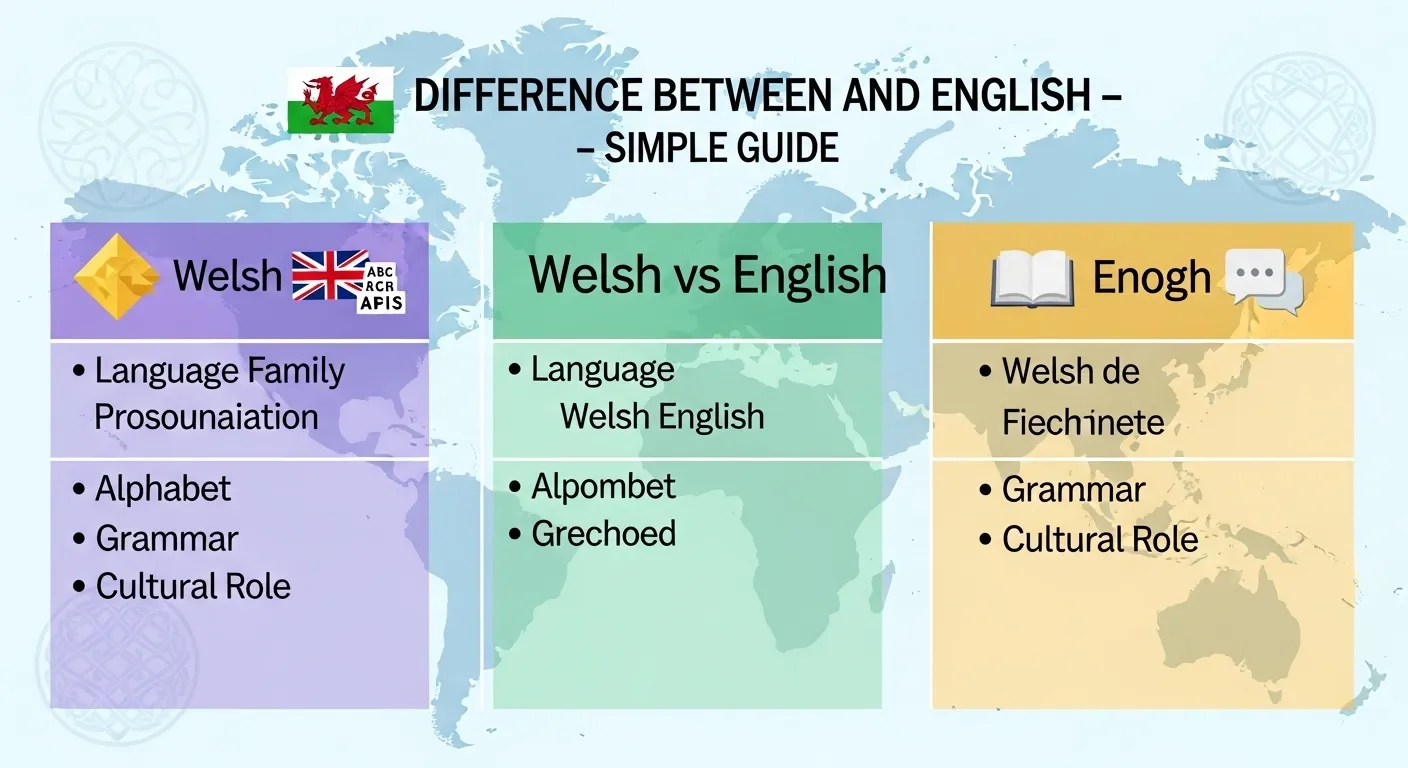
The difference between Welsh and English is clear. Welsh is a Celtic language spoken in Wales. English is a Germanic language spoken worldwide.
Welsh preserves culture and identity. English connects people globally. Both languages are official in Wales.
Knowing the difference between Welsh and English is important for students, travelers, and culture lovers.
Welsh and English have different words, sounds, and grammar. Both are written in Latin letters.
Welsh uses special letters like ŵ and ŷ. English uses standard letters. Both languages are taught in schools.
Both are used in signs and media. Understanding their difference helps in learning, communication, and appreciating Welsh culture.
🔑 Key Differences Between Welsh vs English
| Feature | Welsh | English |
| Language Family | Celtic | Germanic |
| Spoken In | Wales | Worldwide, UK, USA |
| Alphabet | Latin + ŵ, ŷ | Latin |
| Pronunciation | Unique sounds | Standard sounds |
| Vocabulary | Celtic words | Germanic/Latin words |
| Grammar | Consonant mutations | Standard word order |
| Official Status | Wales | UK, globally |
| Usage | Schools, signs, local media | Media, business, global |
| Learning Difficulty | Harder | Easier |
| Example | “Croeso” = Welcome | “Welcome” = Welcome |
📖 Definition of Welsh or English
Welsh is a Celtic language. It is mainly spoken in Wales. Welsh has its own grammar. Words change depending on context. It uses special letters like ŵ and ŷ. Welsh sounds musical. Pronunciation is unique.
English is a Germanic language. It is spoken worldwide. English uses standard letters. Words are easier to learn. Grammar is simpler than Welsh. English is practical for global communication.
Knowing the difference between Welsh and English helps in school, work, and travel. Welsh preserves culture. English spreads knowledge globally.
🌿 Nature and Characteristics
Welsh is musical. Letters like “ll” and “ch” are unique. Words often change form. Mostly spoken in rural Wales. It has a strong link to history. Welsh keeps traditions alive.
English is widely spoken. It borrows words from Latin, French, and German. Grammar is simple. English is practical for communication, business, and education.
Welsh preserves identity. English connects globally. Both are important. Both serve different purposes. Learning both is useful for everyone.
🔊 Pronunciation (US & UK)
- Welsh: /wɛlʃ/
- English: /ˈɪŋɡlɪʃ/
Welsh sounds musical. English is easier for global learners. Both are used in Wales. Both appear on signs, in schools, and media.
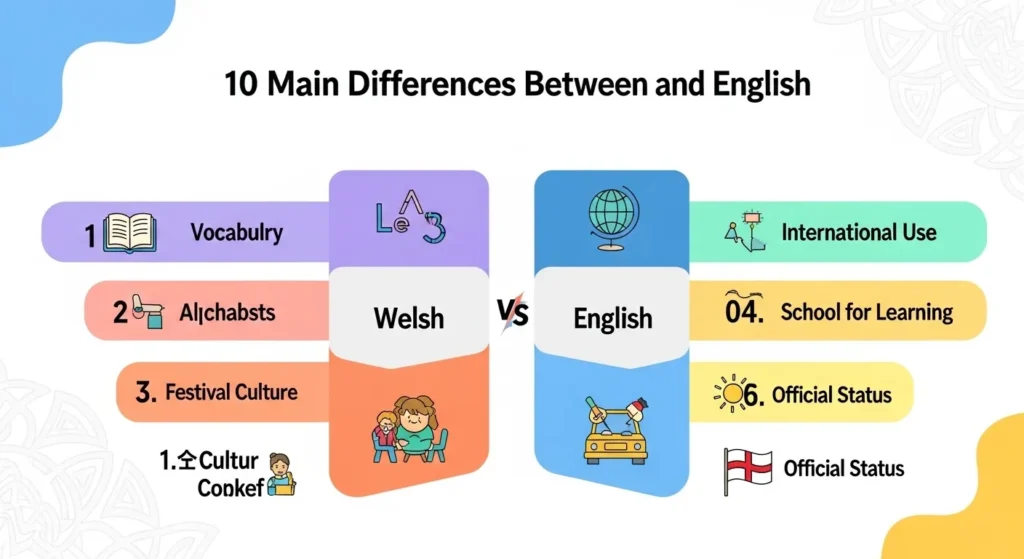
🥄 10 Main Differences Between Welsh and English
1️⃣ Language Family
- Welsh: Celtic origin.
- English: Germanic origin.
- Example: “Llanelli” vs “London.”
- Both have unique roots.
2️⃣ Alphabet and Letters
- Welsh: Special letters like ŵ and ŷ.
- English: Standard letters.
- Example: “Cŵn” = Dogs, “Dogs” = Dogs.
- Writing rules differ.
3️⃣ Pronunciation
- Welsh: Sounds like “ll” in Llanelli.
- English: Standard pronunciation.
- Example: “Llyfr” = Book, “Book” = Book.
- English is easier for beginners.
4️⃣ Vocabulary
- Welsh: Celtic words.
- English: Germanic and Latin words.
- Example: “Cariad” = Love, “Love” = Love.
- Words sound different.
5️⃣ Grammar
- Welsh: Uses consonant mutations.
- English: Standard word order.
- Example: “Pethau da” = Good things, “Good things” = Good things.
- Welsh grammar is unique and musical.
6️⃣ Learning Difficulty
- Welsh: Harder for beginners.
- English: Easier due to global exposure.
- Example: Children learn Welsh in school. English is taught worldwide.
7️⃣ Usage
- Welsh: Schools, street signs, local TV.
- English: Business, media, international communication.
- Example: Road signs in Wales are bilingual.
8️⃣ Cultural Importance
- Welsh: Preserves heritage and identity.
- English: Practical for travel and work.
- Example: Welsh festivals, English business meetings.
9️⃣ Modern Influence
- Welsh: Limited globally. Mostly local.
- English: International language. Used in books, movies, business.
🔟 Official Status
- Welsh: Official language in Wales.
- English: Official in UK and many countries worldwide.
📊 Comparison Table
| Feature | Welsh | English |
| Language Family | Celtic | Germanic |
| Spoken In | Wales | Worldwide |
| Alphabet | Latin + special letters | Latin |
| Pronunciation | Unique sounds | Standard sounds |
| Vocabulary | Celtic origin | Germanic/Latin origin |
| Grammar | Consonant mutations | Standard word order |
| Official Status | Wales | Global |
| Learning Difficulty | Harder | Easier |
| Usage | Local communication | Global communication |
| Cultural Role | Preserves tradition | Practical |
🏰 History of Welsh and English
- Welsh is over 1,500 years old.
- English started around 1,400 years ago.
- Wales was conquered by England in the 13th century.
- English became the language of government.
- Welsh survived in villages and schools.
- Modern Wales teaches both languages.
- Bilingual signs are common today.
- English spread worldwide due to colonization.
- Welsh preserves Celtic culture and identity.
- Learning both is part of modern education.
🏆 Which Is Better in What Situation?
Welsh 🏰
- Best to connect with culture.
- Use in schools, villages, and festivals.
- Example: Reading local newspapers in Welsh.
- Preserves heritage.
English 🌍
- Best for global communication.
- Use in travel, business, and media.
- Example: Talking to international friends.
- Opens global opportunities.
Both are important. Each serves a purpose. Both are useful for students and travelers.
🎭 Metaphors and Similes
- Welsh is like a traditional song. Musical and unique.
- English is like a river. Wide and flowing.
- Welsh is a castle. Strong and old.
- English is a bridge. Connects people everywhere.
- Welsh preserves history. English spreads knowledge.
💭 Connotative Meaning
- Welsh: Cultural, traditional, local.
- Example: “Learning Welsh connects you to heritage.”
- English: Practical, global, accessible.
- Example: “English is important for travel.”
📚 Literature References
- Welsh Myths and Legends – Folklore, Sioned Davies, 2007
- English Grammar Today – Reference, Ronald Carter, 2010
- Celtic Tales – Folktales, Peter Berresford Ellis, 1987
🎬 Movies Featuring Welsh or English
- The Edge of Love – 2008, UK, English & Welsh
- Pride – 2014, UK, Welsh characters featured
- The Englishman Who Went Up a Hill But Came Down a Mountain – 1995, UK
- Hedd Wyn – 1992, UK, Welsh-language film
❓ Frequently Asked Questions
1. Is Welsh harder than English?
Yes. Welsh has unique sounds and grammar.
2. Can English speakers understand Welsh?
No, not without learning.
3. Is Welsh spoken outside Wales?
Very little. Mostly in Wales.
4. Are street signs bilingual?
Yes, in Welsh and English.
5. Can people be fluent in both languages?
Yes, many Welsh people are bilingual.
6. Which language is older?
Welsh is older than modern English.
7. Is English replacing Welsh?
English is common, but Welsh survives in schools and media.
8. Can you write books in Welsh?
Yes, there are many modern Welsh books.
9. Which is easier to learn?
English is easier for beginners.
10. Why learn both?
Learning both helps with culture, communication, and travel.
🌎 How Both Are Useful
- Welsh preserves culture.
- Spoken in schools, media, and festivals.
- English connects globally.
- Used in business, education, and travel.
- Both help in learning and communication.
- Knowing both opens opportunities.
📝 Final Words
Welsh and English coexist in Wales. Welsh is local and cultural. English is global and practical.
Both are important. Knowing the difference between Welsh vs English helps in learning, culture, and communication. Welsh preserves history. English connects the world. Learning both is useful and rewarding.
📌 Conclusion
Welsh is a Celtic language. English is Germanic. Welsh preserves culture. English enables global communication. Both are official in Wales.
Welsh is mostly local. English is global. Knowing the difference between English and Welsh is useful for students, travelers, and culture lovers. Welsh keeps heritage alive.
English opens global opportunities. Together, they make Wales rich in culture and globally connected. Learning both languages is valuable, important, and fun.
Discover More articals!
🛠️ Difference Between Steel and Metal: Simple Guide
⚡ Difference Between Ground and Neutral: Complete Guide
🎬 Difference Between Actor and Actress: Simple Guide

James Whitmore. Labdiff.com is my english grammar comparision website. I explore the history and evolution of English words. I write detailed comparisons explaining why spellings change over time and how British and American English diverged. My articles add depth and credibility to grammar comparison topics.