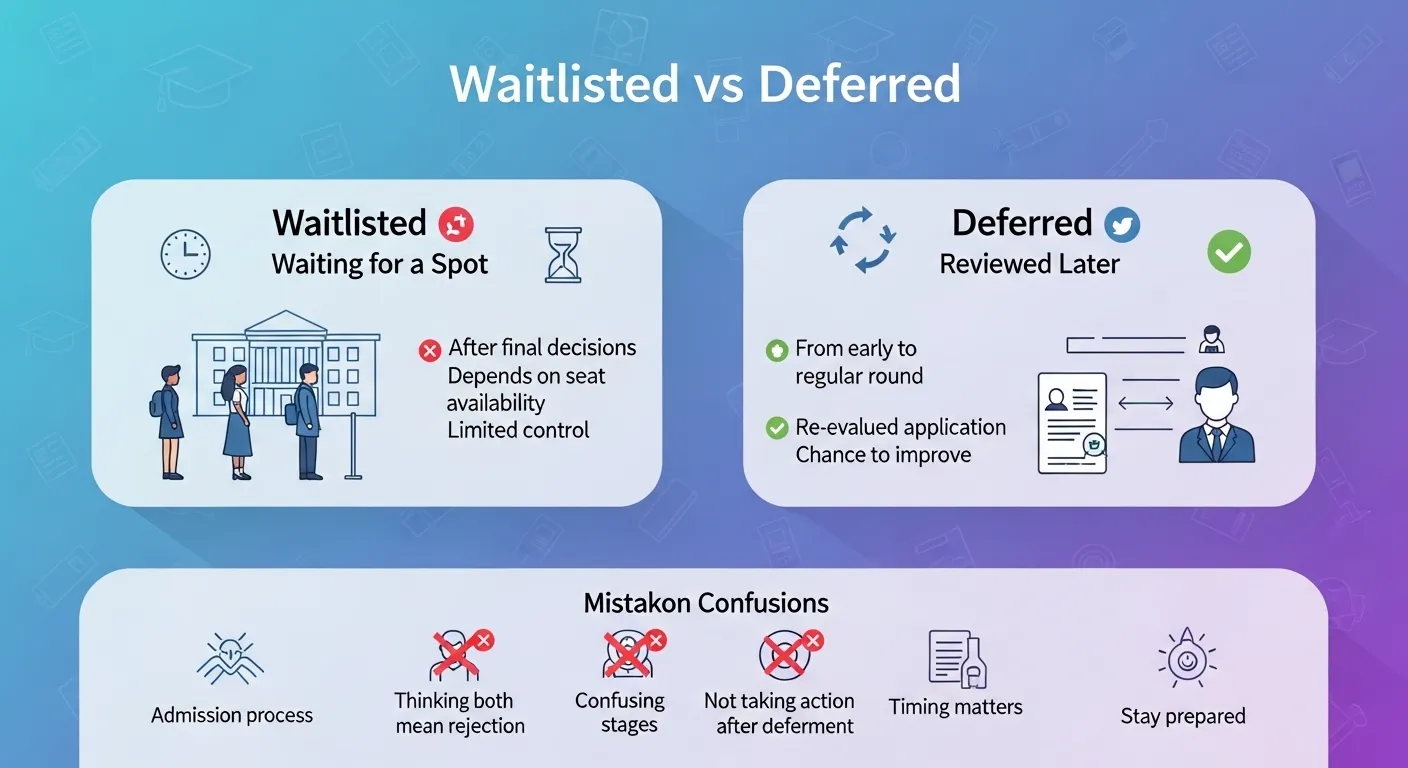
The difference between waitlisted vs deferred is simple. Waitlisted means your admission is on hold after a final decision round, while deferred means your early application is moved to a later round for review.
Imagine a student applying to a university early. He is not accepted yet, but the university wants to review him again later.
He is deferred. Another student applies in the regular round. The university does not reject him but also does not accept him.
He is placed on a waitlist. This real life example clearly explains the difference between waitlisted and deferred.
Many students search questions like “waitlisted vs deferred meaning,” “is deferred better than waitlisted,” and “college waitlist chances.”
These queries show that the difference between waitlisted or deferred is important in college admissions.
Both statuses mean “not accepted yet,” but they happen at different stages. Understanding the difference between deferred and waitlisted helps students respond correctly and plan their next steps.
Key Difference Between the Both
The main difference is timing and stage. Deferred happens during early admissions, while waitlisted happens after final decisions when seats are limited.
Why Their Difference Is Necessary for Learners and Experts
Understanding this difference helps students make better decisions. Deferred students can strengthen their applications before the next review. Waitlisted students must decide if they want to stay on the list and wait for a seat.
Counselors and educators use these terms to guide students properly. Knowing the difference reduces confusion and helps in planning academic goals and backup options.
Pronunciation (US & UK)
| Term | US Pronunciation | UK Pronunciation |
| Waitlisted | /ˈweɪtˌlɪstɪd/ | /ˈweɪtˌlɪstɪd/ |
| Deferred | /dɪˈfɜːrd/ | /dɪˈfɜːd/ |
Now that the basics are clear, let’s explore the detailed difference between waitlisted and deferred.
Difference Between the Keywords
1. Basic Meaning
Waitlisted means delayed decision after final round. Deferred means moved to a later review round.
Example 1:
He was waitlisted after regular decision.
Example 2:
She was deferred from early action.
2. Admission Stage
Deferred occurs in early admissions. Waitlisted occurs after decisions are released.
Example 1:
Early applicant gets deferred.
Example 2:
Regular applicant gets waitlisted.
3. Chance of Admission
Deferred applicants may have stronger chances. Waitlisted chances depend on available seats.
Example 1:
Deferred student is reviewed again.
Example 2:
Waitlisted student depends on others declining offers.
4. Review Process
Deferred applications are re evaluated fully. Waitlisted applications are only considered if space opens.
Example 1:
Deferred file is reviewed again.
Example 2:
Waitlisted file is used as backup.
5. Student Action
Deferred students can improve their application. Waitlisted students can only wait or confirm interest.
Example 1:
Deferred student sends new grades.
Example 2:
Waitlisted student accepts waitlist offer.
6. Timing
Deferred decisions come later in the same cycle. Waitlist decisions come after final admissions.
Example 1:
Deferred result comes in regular round.
Example 2:
Waitlist decision comes after offers.
7. Control
Deferred students have some control. Waitlisted students have little control.
Example 1:
Deferred student updates profile.
Example 2:
Waitlisted student waits for response.
8. Outcome Possibilities
Deferred can lead to acceptance or rejection. Waitlisted can lead to acceptance or no offer.
Example 1:
Deferred student may get accepted later.
Example 2:
Waitlisted student may not get a seat.
9. Emotional Impact
Deferred gives hope with action. Waitlisted creates uncertainty.
Example 1:
Deferred student works to improve.
Example 2:
Waitlisted student waits with uncertainty.
10. Common Use
Deferred is used in early decision systems. Waitlist is used in final admissions.
Example 1:
Universities defer early applicants.
Example 2:
Universities create waitlists for extra applicants.
Nature and Behaviour Of waitlisted and deferred
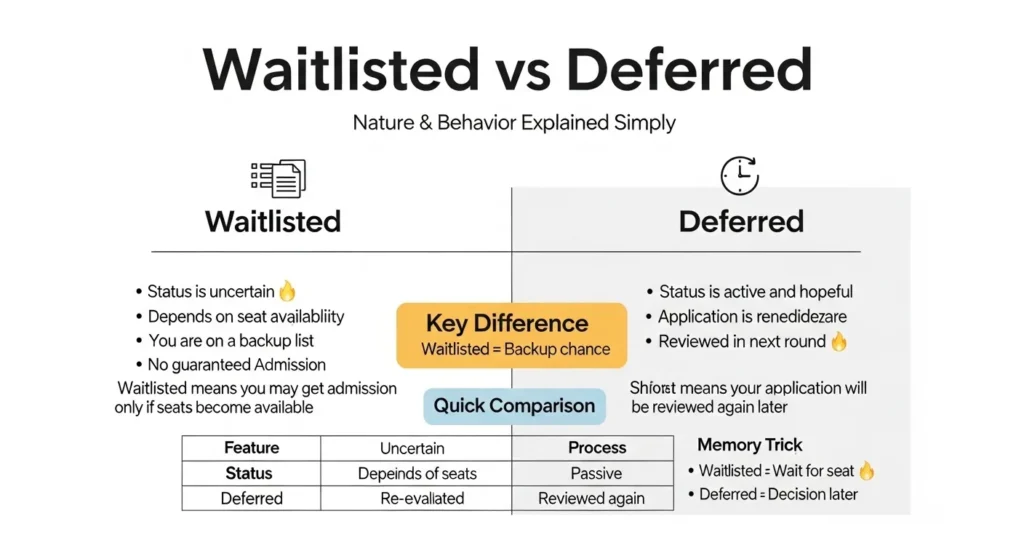
Nature of Waitlisted
Waitlisted status is uncertain and depends on seat availability. It is like being in a backup list.
Nature of Deferred
Deferred status is active and hopeful. It allows re evaluation in the next round.
Why People Are Confused About Their Use
Both mean the student is not accepted yet. Many think they are the same. However, their timing and process are different.
Table Showing Difference and Similarity
| Feature | Waitlisted | Deferred | Similarity |
| Stage | Final stage | Early stage | Both delay decision |
| Control | Low | Moderate | Both not final |
| Outcome | Depends on seats | Re evaluation | Both may lead to acceptance |
| Timing | After decisions | Before final decisions | Both in admission process |
| Action | Wait | Improve application | Both require patience |
Which Is Better in What Situation
When Deferred Is Better
Deferred is better because it gives a second chance. Students can improve grades, add achievements, and strengthen their application before review.
When Waitlisted Is Better
Waitlisted can still lead to admission if seats open. It is useful when the university is highly competitive and students want to stay in consideration.
How the Keywords Are Used in Metaphors and Similes
Waitlisted metaphor:
Example: “He felt waitlisted in life, waiting for his turn.”
Deferred metaphor:
Example: “Her dreams were deferred but not forgotten.”
Connotative Meaning
Waitlisted neutral or slightly negative
Example: “Being waitlisted creates uncertainty.”
Deferred neutral or slightly positive
Example: “Deferred gives another chance.”
Idioms or Proverbs Related to the Words
Good things come to those who wait
Example: Waitlisted students hope for admission.
Delay is not denial
Example: Deferred students stay hopeful.
Works in Literature
- A Dream Deferred Poetry, Langston Hughes, 1951
- The College Admission Guide Education, 2010
- Higher Education Process Academic Text, 2015
Movies Related to the Keywords
- Accepted 2006, United States
- The Perfect Score 2004, United States
- Admission 2013, United States
Frequently Asked Questions
1. What is the difference between waitlisted and deferred?
Deferred means reviewed later, while waitlisted means waiting for available seats.
2. Is deferred better than waitlisted?
Yes. Deferred gives a better chance.
3. Can waitlisted students get accepted?
Yes. If seats become available.
4. What should deferred students do?
Improve grades and submit updates.
5. Should I accept a waitlist offer?
Yes, if you are still interested.
How Both Are Useful for Surroundings
Both systems help universities manage admissions. They allow fair selection and efficient use of available seats.
Final Words for the Both
Waitlisted and deferred are not final outcomes. They are part of the admission process.
Conclusion
The difference between waitlisted and deferred lies in timing, opportunity, and control within the admission process. Deferred students are moved from early applications to a later round, which gives them another chance to be evaluated.
This stage allows improvement and keeps hope active. On the other hand, waitlisted students have already passed the main selection stage but must wait for available seats. Their chances depend on other students declining offers.
Both statuses can be confusing, but they serve different purposes. Deferred offers a second review opportunity, while waitlisted works as a backup system for universities. Students should understand their position clearly and take the right steps.
Deferred students should strengthen their profile, while waitlisted students should confirm their interest and prepare alternatives.
Understanding the difference between waitlisted and deferred helps students stay calm, make informed decisions, and plan their future wisely during the admission journey.
Discover More Articals!
Difference Between Femboy and Transn
Difference Between Remote and Teleworka

James Whitmore. Labdiff.com is my english grammar comparision website. I explore the history and evolution of English words. I write detailed comparisons explaining why spellings change over time and how British and American English diverged. My articles add depth and credibility to grammar comparison topics.