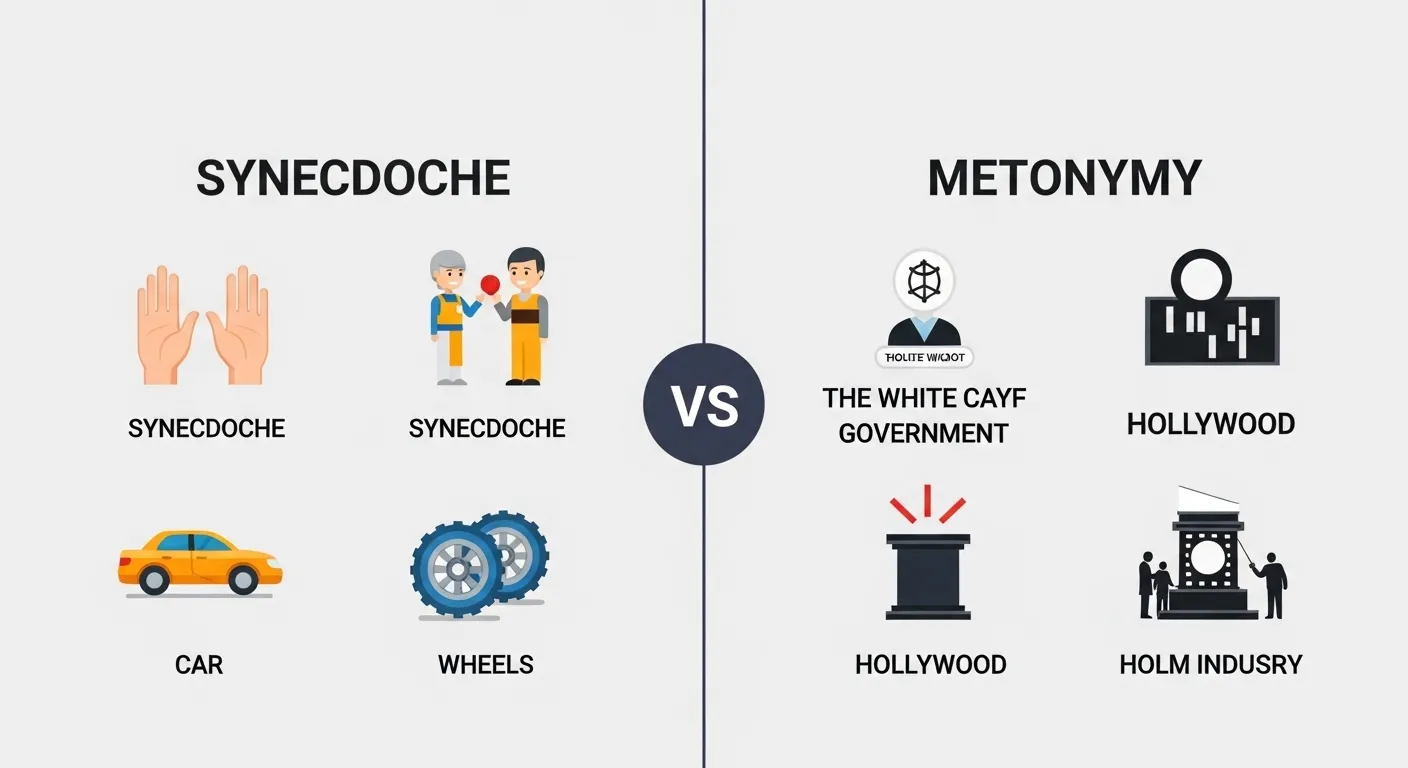
Synecdoche uses a part to represent the whole (or vice versa), while metonymy replaces something with a related concept or association.
In language and literature, writers often use figures of speech to make their expressions more vivid and meaningful.
Two common rhetorical devices are synecdoche and metonymy. These terms may seem complex at first, but they are widely used in everyday communication, literature, and speeches.
Many students and writers confuse them because both involve replacing one word with another related word. However, there is a clear difference between synecdoche and metonymy.
Synecdoche works by using a part of something to represent the whole, or sometimes the whole to represent a part.
Metonymy, on the other hand, replaces a word with something closely related to it but not actually a part of it. Because of this similarity, people sometimes mix them up.
Understanding the difference between synecdoche and metonymy helps readers appreciate literary writing more deeply.
It also helps writers communicate ideas in a more creative way. Learning the difference between synecdoche and metonymy improves both vocabulary and understanding of figurative language.
📖 Definitions
📌 Definition of Synecdoche
Synecdoche is a figure of speech where a part of something represents the whole, or sometimes the whole represents a part.
In this technique, the word used is directly connected as a physical or structural part of the thing being described.
Example:
“All hands on deck.”
Here, the word hands represents the sailors or crew members.
📌 Definition of Metonymy
Metonymy is a figure of speech in which one word is replaced with another word that is closely associated with it, but not necessarily a physical part of it.
The connection is based on relationship, association, or symbolism.
Example:
“The White House issued a statement.”
Here, White House represents the U.S. government or president.
🔍 Difference Between Synecdoche and Metonymy
1️⃣ Scope
Synecdoche:
Represents a part standing for the whole.
Sometimes the whole represents a part.
Metonymy:
Uses a related concept to represent something.
The replacement is symbolic or associative.
Examples
Synecdoche example:
“Nice wheels” meaning a car.
Metonymy example:
“Hollywood produces many movies.”
2️⃣ Purpose
Synecdoche:
Highlights a specific part of something.
Metonymy:
Creates symbolic or contextual meaning.
Examples
Synecdoche example:
“Boots on the ground” meaning soldiers.
Metonymy example:
“The crown announced a decision.”
3️⃣ Relationship Type
Synecdoche:
The word used is physically part of the object.
Metonymy:
The word used is related but not a part.
Examples
Synecdoche example:
“Counting heads” meaning counting people.
Metonymy example:
“Wall Street reacted to the news.”
4️⃣ Structure
Synecdoche:
Part-to-whole relationship.
Metonymy:
Association-based relationship.
Examples
Synecdoche example:
“Many mouths to feed.”
Metonymy example:
“The pen is mightier than the sword.”
5️⃣ Usage in Literature
Synecdoche:
Often used to emphasize physical elements.
Metonymy:
Used to represent institutions or concepts.
Examples
Synecdoche example:
“Strong arms built the city.”
Metonymy example:
“The press reported the event.”
6️⃣ Emotional Impact
Synecdoche:
Creates vivid imagery by focusing on parts.
Metonymy:
Creates symbolic meaning and cultural associations.
Examples
Synecdoche example:
“Working hands shaped the land.”
Metonymy example:
“The stage welcomed the performer.”
7️⃣ Communication Style
Synecdoche:
Often used in descriptive writing.
Metonymy:
Common in political speech and journalism.
Examples
Synecdoche example:
“Every eye watched the performance.”
Metonymy example:
“Downing Street released a statement.”
8️⃣ Cultural Role
Synecdoche:
Appears frequently in poetry and storytelling.
Metonymy:
Common in media, politics, and headlines.
Examples
Synecdoche example:
“Hardworking hands built the nation.”
Metonymy example:
“Silicon Valley leads technology innovation.”
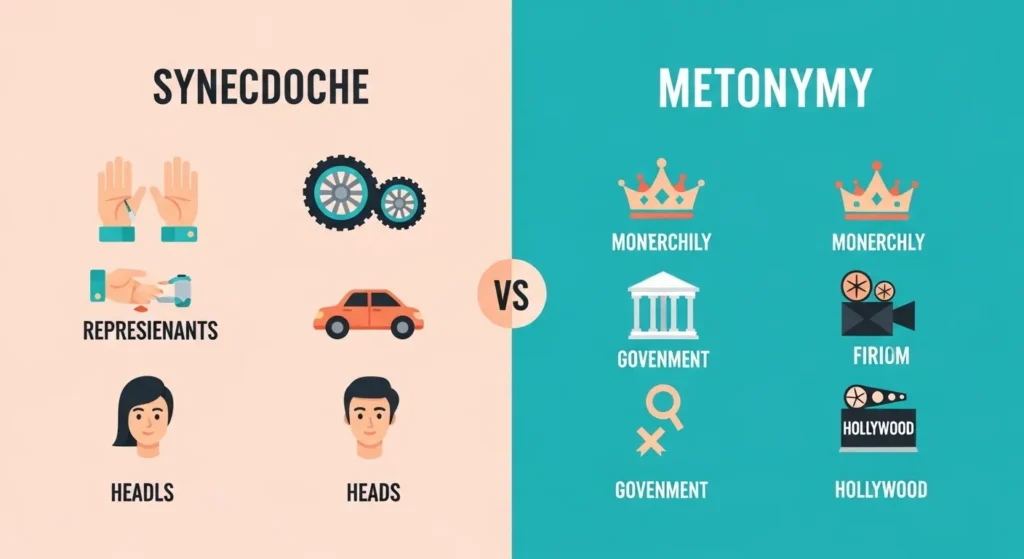
9️⃣ Examples
Synecdoche Examples
“Hands” for workers
“Wheels” for cars
“Faces” for people
Metonymy Examples
“The crown” for monarchy
“The White House” for the U.S. government
“Hollywood” for the film industry
🔟 Key Difference Summary
The main difference between synecdoche and metonymy lies in their relationship with the original concept.
Synecdoche uses a part of something to represent the whole (or vice versa).
Metonymy uses something closely related or associated to represent it.
Understanding the difference between synecdoche and metonymy helps readers recognize figurative language more easily.
🏁 Conclusion
The difference between synecdoche vs metonymy is based on the type of relationship between the words used. Both are figures of speech that replace one term with another related term, but the nature of that relationship is different.
Synecdoche focuses on a part-to-whole relationship. A small part of something represents the entire object or group.
For example, saying “all hands on deck” uses the word hands to represent sailors. This technique helps create vivid imagery and concise descriptions in writing.
Metonymy, in contrast, relies on association rather than physical parts. It replaces a word with something closely connected to it.
For instance, saying “the White House made a statement” uses the building to represent the people or administration inside it. This approach is often used in journalism, politics, and literature.
Understanding the difference between metonymy or synecdoche allows readers and writers to appreciate the richness of language. These devices make communication more expressive and powerful.
By recognizing the difference between synecdoche and metonymy, people can better interpret literary works and use figurative language effectively in their own writing.
Discover More Articals!
🎬 Difference Between Actor and Actress: Simple Guide
⚡ Difference Between Ground and Neutral: Complete Guide
🛠️ Difference Between Steel and Metal: Simple Guide

labdiff.com is my English grammar comparison website where I simplify confusing words, spelling differences, and usage rules through clear explanations and examples. My goal is to help learners, writers, and students understand English easily and use correct grammar with confidence.