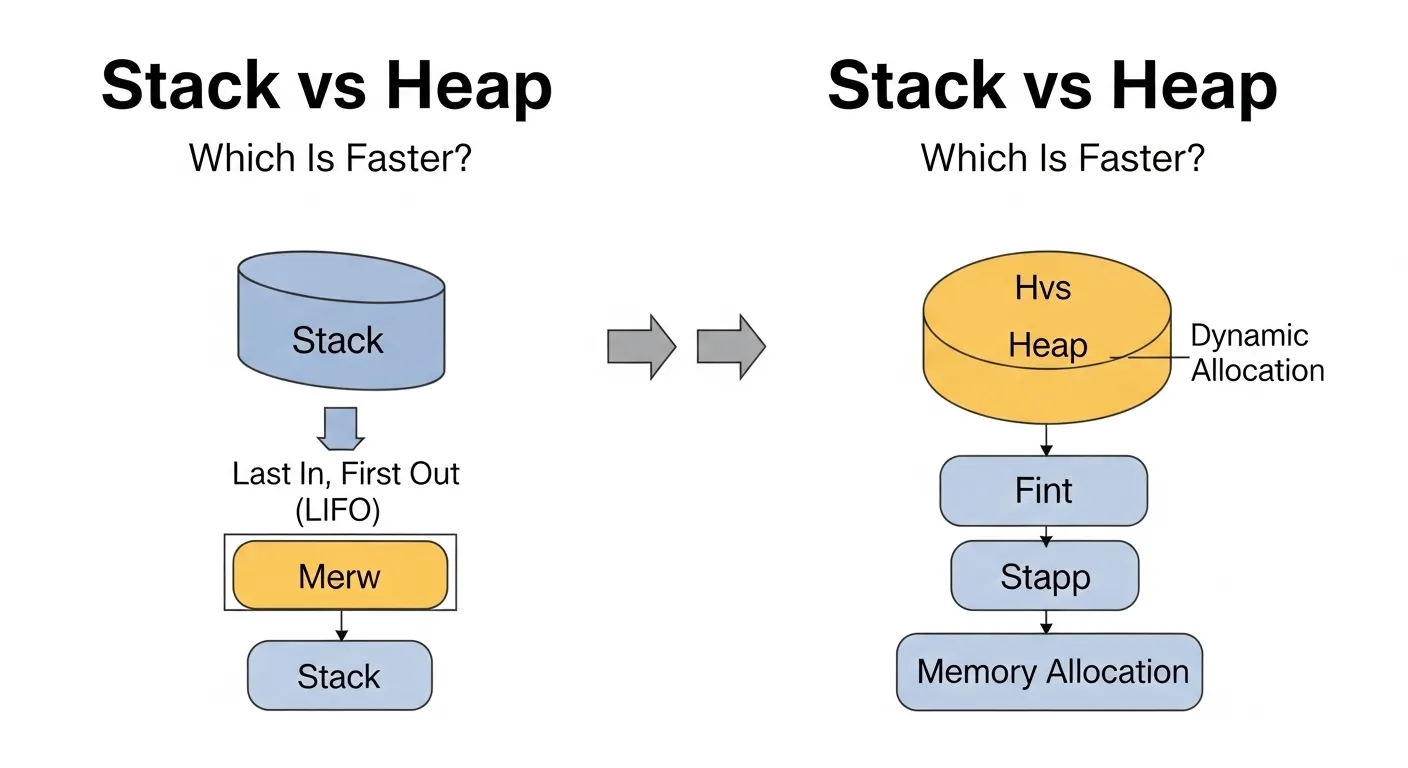
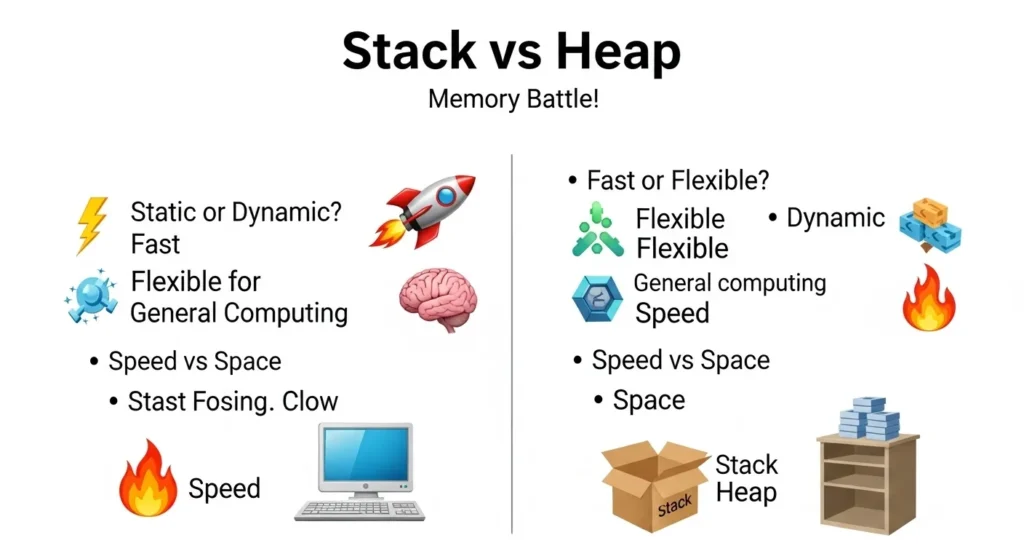
Stack vs Heap: Stack stores temporary data with fast access (like function calls), while heap stores dynamic data with flexible size but slower access.
When I started programming, I heard about stack and heap. Both are types of memory. At first, I did not understand the difference between stack or heap. They both store data. They both are part of RAM. But they work in different ways.
The difference between stack and heap is mainly about how memory is stored and managed. Stack memory is automatic and fast. Heap memory is dynamic and flexible.
Understanding the difference between stack and stack helps programmers avoid errors. Once you learn the difference between stack and heap, coding becomes easier.
🔑 Key Difference Between the Both
The main difference between stack and heap is that stack memory is automatically managed and follows LIFO order, while heap memory is dynamically managed and does not follow a fixed order.
🎓 Why Is Their Difference Important?
Knowing the difference between stack and heap is important for students and developers. It helps prevent stack overflow and memory leaks. Beginners learn memory basics. Experts improve performance and efficiency.
🔊 Pronunciation
🗣️ Stack
- US: /stæk/
- UK: /stæk/
🗣️ Heap
- US: /hiːp/
- UK: /hiːp/
Now let’s see the detailed differences.
🧠 Difference Between Stack and Heap
📖 Definition of Stack
Stack is memory used for local variables and function calls. It follows Last In, First Out (LIFO).
📖 Definition of Heap
Heap is memory used for dynamic allocation. It stores objects and large data.
1️⃣ Memory Allocation
Stack: Static allocation.
- Example: Local variable in a function.
- Example: Function parameters.
Heap: Dynamic allocation.
- Example: Object created with new.
- Example: Memory using malloc().
2️⃣ Memory Management
Stack: Managed automatically.
- Example: Cleared after function ends.
- Example: No manual deletion.
Heap: Managed manually or by GC.
- Example: Use free() in C.
- Example: Garbage collection in Java.
3️⃣ Speed
Stack: Faster.
- Example: Quick variable access.
- Example: Fast function calls.
Heap: Slower.
- Example: Takes time to allocate.
- Example: Slower lookup.
4️⃣ Structure
Stack: Follows LIFO.
- Example: Last function returns first.
- Example: Nested calls.
Heap: No fixed order.
- Example: Random storage.
- Example: Any block allocation.
5️⃣ Size
Stack: Limited size.
- Example: Stack overflow error.
- Example: Deep recursion crash.
Heap: Larger size.
- Example: Large arrays.
- Example: Big data storage.
6️⃣ Data Storage
- Example: int, float.
- Example: Boolean values.
Heap: Stores objects.
- Example: Class objects.
- Example: Linked list nodes.
7️⃣ Lifetime
Stack: Short lifetime.
- Example: Variable inside function.
- Example: Removed after execution.
Heap: Long lifetime.
- Example: Object stays in memory.
- Example: Removed when deleted.
8️⃣ Flexibility
Stack: Less flexible.
- Example: Fixed size.
- Example: No resizing.
Heap: More flexible.
- Example: Dynamic arrays.
- Example: Resize at runtime.
9️⃣ Risk
Stack: Stack overflow.
- Example: Infinite recursion.
- Example: Too many calls.
Heap: Memory leak.
- Example: Not freeing memory.
- Example: Unused objects.
🔟 Usage
Stack: Function execution.
- Example: Call stack.
- Example: Local tasks.
Heap: Large data storage.
- Example: Objects in OOP.
- Example: Data caching.
🌿 Nature and Behavior
📦 Stack
Stack is fast and organized. It works like a pile of plates.
🗄️ Heap
Heap is flexible and large. It works like open storage.
🤔 Why Are People Confused?
Both are memory areas. Both store data. Beginners think they are the same. But their management is different.
📊 Difference and Similarity Table
| Feature | Stack | Heap | Similarity |
| Allocation | Static | Dynamic | Both in RAM |
| Management | Automatic | Manual/GC | Store data |
| Speed | Faster | Slower | Used in programs |
| Size | Limited | Larger | Memory areas |
| Risk | Stack overflow | Memory leak | Can cause errors |
🏆 Which Is Better in What Situation?
📦 Stack (Best for Small and Fast Tasks)
Stack is best for small variables and quick tasks. It is fast and automatic. It is good for short-term data. Use it when size is predictable.
🗄️ Heap (Best for Large and Dynamic Data)
Heap is best for large objects. It is flexible. It is useful for dynamic programs. Use it when memory size changes.
✍️ Metaphors
- Stack of books.
- Heap of garbage.
Example:
- Tasks were handled like a stack.
- Problems formed a heap.
🎭 Connotative Meaning
Stack: Organized and neat.
Heap: Large and messy.
❓ FAQs
1. Which is faster?
Stack is faster.
2. What causes stack overflow?
Too many function calls.
3. What causes memory leak?
Not freeing heap memory.
4. Is heap bigger?
Yes, usually.
5. Are both in RAM?
Yes.
🌍 Usefulness
Stack helps fast execution. Heap helps store large data. Both are necessary.
📝 Final Words
Stack and heap are important memory areas. They work differently but support each other.
📌 Conclusion
The difference between stack and heap is about allocation and management. Stack is fast and automatic. Heap is flexible and dynamic.
Understanding the difference between stack and heap improves coding skills. Once you learn the difference between stack and heap, memory management becomes simple.
Discover More Articals!
Difference Between Risk and Vulnerability: In(2026)
Difference Between Fog and Clouds: Clear Guide for Everyone

James Whitmore. Labdiff.com is my english grammar comparision website. I explore the history and evolution of English words. I write detailed comparisons explaining why spellings change over time and how British and American English diverged. My articles add depth and credibility to grammar comparison topics.