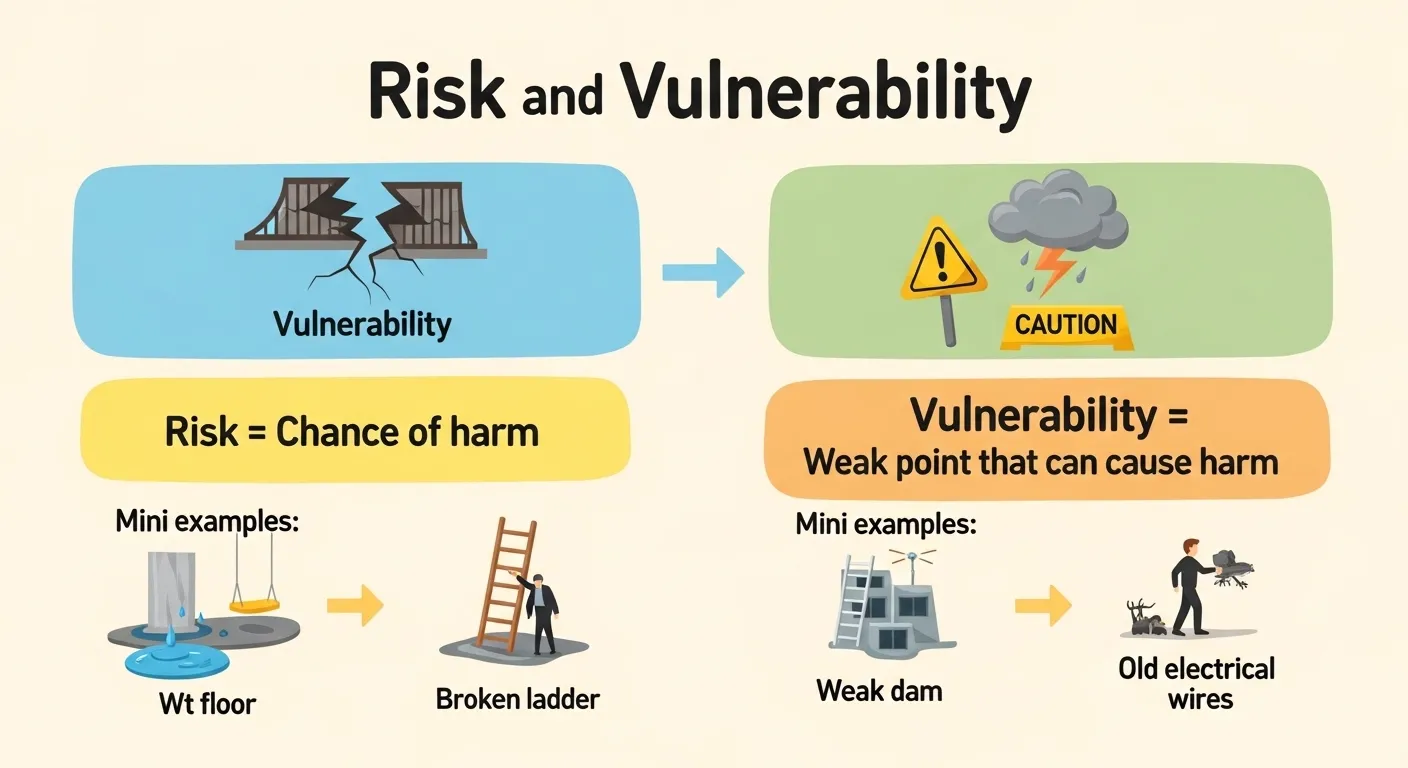
The difference between risk and vulnerability is that risk is the chance of something bad happening, and vulnerability is a weakness that can cause harm.
Both are connected but different. Knowing both helps us stay safe in school, home, playground, or anywhere.
Think of a house with a weak roof. The weak roof is a vulnerability. If a storm comes, the chance of damage is the risk.
The roof does not cause damage by itself, but the storm combined with the weak roof creates a risk. Understanding both is important for safety and smart decision :making.
Difference Between Risk and Vulnerability (Risk vs Vulnerability Explained)
The difference between risk and vulnerability is important for understanding safety. Risk is the chance that something bad may happen, while vulnerability is a weakness that allows harm to occur.
The terms risk and vulnerability are often used together because they are closely connected. A vulnerability on its own does not cause harm, but when combined with a possible threat, it creates risk.
In simple words, the risk vulnerability relationship means that weaknesses increase the chances of danger. Understanding the vulnerability and risk difference helps people identify problems early and take action to stay safe.
Pronunciation
- Risk: US /rɪsk/, UK /rɪsk/
- Vulnerability: US /ˌvʌl :nər :ə- :bi :lə :tee/, UK /ˌvʌl :nər :ə- :bi :lə :tee/
Why Students Should Know About Risk and Vulnerability
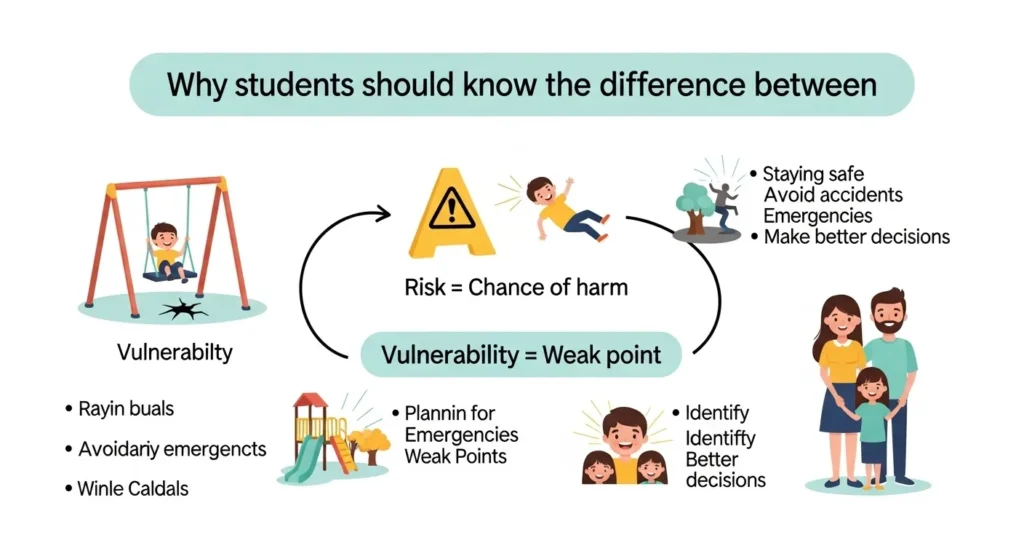
Knowing the difference between risk and vulnerability helps students, teachers, and families:
- Stay safe in daily life.
- Avoid accidents at home, school, or playground.
- Plan for emergencies.
- Identify weak points in things around us.
- Make better decisions in risky situations.
Example: A playground swing has a crack. The crack is a vulnerability. If a child plays on it, the chance of falling is the risk. Fixing the swing removes the vulnerability, which lowers the risk.
10 Key Differences Between Risk and Vulnerability
1. Meaning
- Risk: The chance that something bad may happen.
- Vulnerability: Weak point or flaw that can cause harm.
Example 1: Wet floor in school is a vulnerability. The chance of a student slipping is the risk.
Example 2: Broken electrical wire is a vulnerability. The risk is getting an electric shock.
2. Focus
- Risk focuses on what could happen.
- Vulnerability focuses on the weak point itself.
Example:
- Risk: Falling off a weak swing.
- Vulnerability: Crack in the swing seat.
3. Nature
- Risk is dynamic. It changes with events and situations.
- Vulnerability is static. It remains until fixed.
Example:
- Risk: Probability of a tree falling during a storm.
- Vulnerability: Weak roots of the tree.
4. Measurement
- Risk: Measured by how likely it is and how serious it can be.
- Vulnerability: Measured by the number and type of weaknesses.
Example:
- Risk: Chance of car accident on rainy roads.
- Vulnerability: Worn :out tires increase the risk.
5. Examples
- Risk: Slipping on wet floor.
- Vulnerability: Wet floor itself.
- Risk: Fire in the kitchen.
- Vulnerability: Faulty gas stove.
6. Control
- Risk: Can be managed with planning, carefulness, or insurance.
- Vulnerability: Can be reduced by fixing weak points.
Example:
- Risk: Avoiding the playground when it is slippery.
- Vulnerability: Fixing broken swings to make them safe.
7. Dependency
- Risk depends on a threat and a vulnerability.
- Vulnerability exists even without a threat.
Example:
- Risk: Chance of flood in a weak dam area.
- Vulnerability: Weak dam wall exists before flood occurs.
8. Time Sensitivity
- Risk changes over time. It may increase or decrease.
- Vulnerability stays until addressed.
Example:
- Risk: Storm probability may change each day.
- Vulnerability: Cracked bridge remains a weak point until repaired.
9. Outcome
- Risk: Can cause harm, damage, or loss.
- Vulnerability: Does not cause harm by itself but makes risk higher.
Example:
- Risk: Chance of a student falling and getting hurt.
- Vulnerability: Broken ladder in classroom.
10. Usage
- Risk: Commonly used in schools, safety drills, finance, and projects.
- Vulnerability: Used to find weak points in buildings, playgrounds, or IT systems.
Table for Easy Understanding
| Feature | Risk | Vulnerability |
| Meaning | Chance of something bad | Weakness that may cause harm |
| Change | Can change | Stays until fixed |
| Example | Slipping on wet floor | Wet floor itself |
| Control | Plan and prevent | Fix weak points |
| Dependency | Needs threat + weakness | Exists alone |
Which One is More Useful?
- Risk: Helps us plan and prevent accidents.
- Vulnerability: Helps us find weak points and fix them.
Both are important. Risk shows what might happen. Vulnerability shows what must be repaired. Together, they make environments safer.
Easy Daily Life Examples
- Walking on a broken bridge: Risk = falling, Vulnerability = broken planks.
- Eating too much junk food: Risk = stomachache, Vulnerability = weak stomach.
- Using old electrical wires: Risk = electric shock, Vulnerability = worn :out wire.
- Crossing a busy street: Risk = getting hit by car, Vulnerability = no zebra crossing.
- Playing in a wet playground: Risk = slipping, Vulnerability = wet floor or broken equipment.
Stories for Students
Story 1:
Rina sees a swing with a crack. She knows it is vulnerable. The risk is that a child may fall while playing. She informs the teacher, and the swing is fixed. Everyone is safe.
Story 2:
Ali notices puddles on the playground. The puddles are vulnerabilities. The risk is slipping. Ali avoids running near them. No one gets hurt.
Story 3:
A school lab has old electrical wires. These wires are vulnerabilities. The risk is electric shock if students touch them. The teacher repairs the wires. Now the lab is safe.
Fun Questions for Students
- What is risk?
- Chance of something bad happening.
- What is vulnerability?
- Weak point that can cause harm.
- Can vulnerability cause harm alone?
- No. Harm happens only when risk meets vulnerability.
- Can risk change?
- Yes. It changes with events or situations.
- Why is it important to know both?
- To prevent accidents and fix weak points.
Metaphors and Similes
- Risk is like a storm approaching.
- Vulnerability is like a hole in your umbrella.
- Risk is the chance of being hurt. Vulnerability is what makes it possible.
Why People Get Confused
Many students think weakness automatically causes harm. But weakness alone is not harmful. Risk only happens when a threat meets a weak point.
How Risk and Vulnerability Help in Daily Life
- At school: Risk assessment prevents accidents. Fixing vulnerabilities makes playgrounds safer.
- At home: Identifying vulnerabilities like broken furniture lowers risk.
- In sports: Checking equipment for vulnerabilities prevents injuries.
- In projects: Risk management helps plan for mistakes.
- In IT/online: Fixing vulnerabilities in computers prevents hacking risks.
Real:Life Situations
- Natural disasters: Weak dam = vulnerability. Flood probability = risk.
- Health: Weak immunity = vulnerability. Risk of illness increases.
- Travel: Broken car brakes = vulnerability. Risk of accidents increases.
- Finance: Weak savings = vulnerability. Risk of losing money in emergencies.
Literature Examples
- Risk Society (Sociology, Ulrich Beck, 1992)
- Vulnerable People (Fiction, John Doe, 2010)
- The Risk of Security (IT guide, Smith, 2015)
Movies About Risk and Vulnerability
- Risk (2016, India)
- Vulnerability (2019, USA)
- The Risk Takers (2014, UK)
Idioms and Proverbs
- “Better safe than sorry.” Fix vulnerabilities to reduce risk.
- “Don’t put all eggs in one basket.” Avoid concentrating risk in one weak area.
- “Look before you leap.” Assess risk before acting.
Final Words
Risk and vulnerability are connected but different. Risk shows what may happen. Vulnerability shows what is weak. Understanding both helps students, teachers, and families stay safe.
Fixing vulnerabilities reduces risk. Risk assessment guides us to prevent harm. Together, they make life safer and smarter.
Conclusion
The difference between risk and vulnerability is simple. Risk is the chance of harm. Vulnerability is a weak point.
Students can stay safe by knowing both. Fixing vulnerabilities lowers risk. Risk assessment helps in planning and preparation.
Together, risk and vulnerability make homes, schools, playgrounds, and daily life safer.
Discover More Posts!
🎨 Difference Between Paint and Stain: Simple Guide
Difference Between Cupboard and Cabinet: With In 30 Seconds

James Whitmore. Labdiff.com is my english grammar comparision website. I explore the history and evolution of English words. I write detailed comparisons explaining why spellings change over time and how British and American English diverged. My articles add depth and credibility to grammar comparison topics.