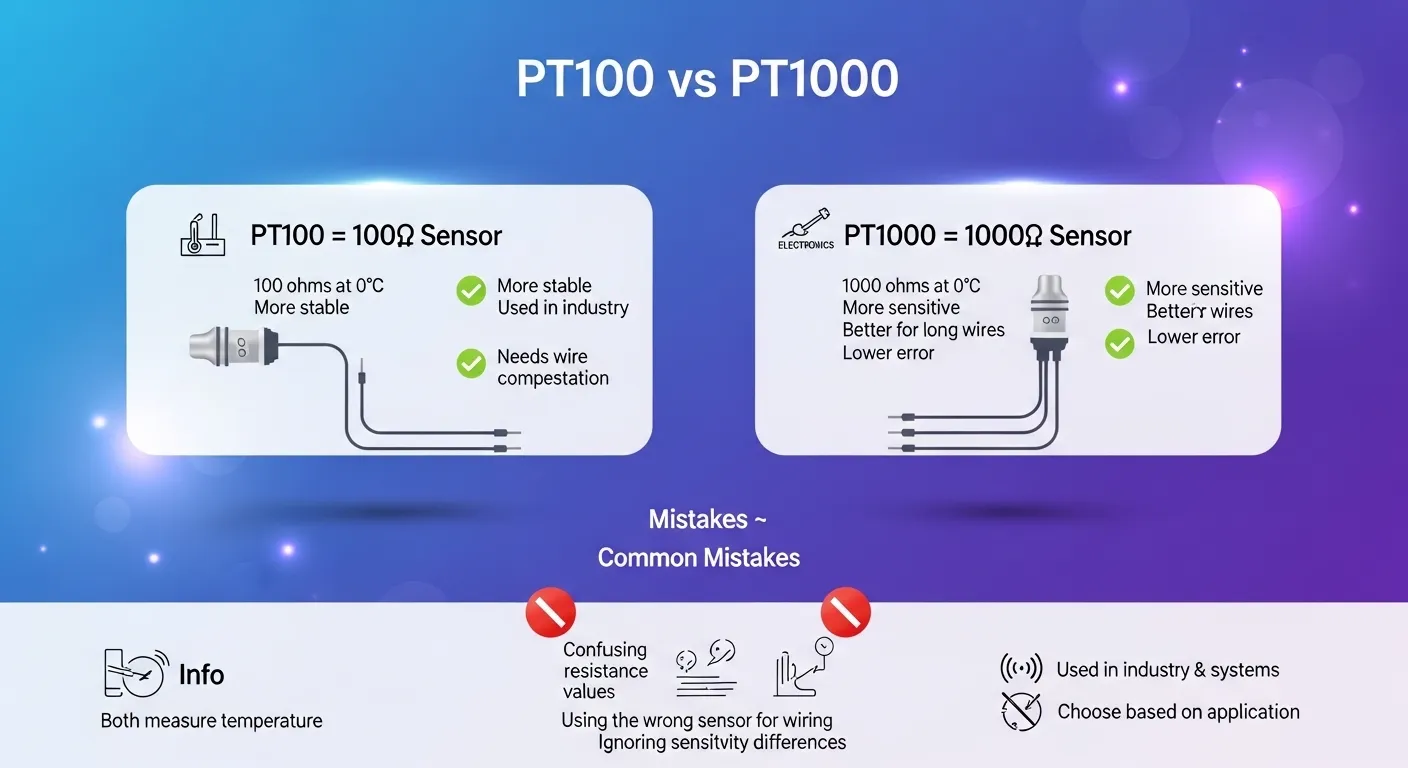
The difference between PT100 and PT1000 is simple. PT100 has 100 ohms resistance at 0°C, while PT1000 has 1000 ohms at 0°C. Imagine two temperature sensors in a factory. One is used in a noisy environment.
The other is used where high accuracy is needed over long wires. The first is often PT100. The second is PT1000. This real life case explains the difference between PT100 and PT1000 clearly.
Many users search queries like “PT100 vs PT1000 accuracy,” “which is better PT100 or PT1000,” and “difference between PT100 and PT1000 sensor.”
These show that the difference between PT100 vs PT1000 matters in industry and electronics. Both are resistance temperature detectors.
But they behave differently. Understanding the difference between PT100 and PT1000 helps in choosing the right sensor.
Key Difference Between the Both
The main difference is resistance value. PT100 has 100Ω. PT1000 has 1000Ω at 0°C.
Why Their Difference Is Necessary for Learners and Experts
This difference is important in measurement systems. Engineers choose sensors based on accuracy and wiring. PT100 is common in industry. PT1000 is better for long cables and low error.
Students learn sensor behavior. Professionals design better systems. This knowledge improves measurement quality.
Pronunciation (US & UK)
| Term | US Pronunciation | UK Pronunciation |
| PT100 | /piː tiː wʌn ˈhʌndrəd/ | /piː tiː wʌn ˈhʌndrəd/ |
| PT1000 | /piː tiː ˈθaʊzənd/ | /piː tiː ˈθaʊzənd/ |
Now let’s explore the difference between PT100 and PT1000 in detail.
Definition with Examples
PT100 Definition
PT100 is a temperature sensor. It has 100 ohms at 0°C.
Example 1:
Used in industrial machines.
Example 2:
Used in laboratory equipment.
PT1000 Definition
PT1000 is a temperature sensor. It has 1000 ohms at 0°C.
Example 1:
Used in HVAC systems.
Example 2:
Used in long cable setups.
Difference Between the Keywords
1. Resistance Value
PT100 has 100Ω. PT1000 has 1000Ω.
Example 1:
PT100 reads 100Ω at 0°C.
Example 2:
PT1000 reads 1000Ω at 0°C.
2. Sensitivity
PT1000 is more sensitive. PT100 is less sensitive.
Example 1:
PT100 detects changes slower.
Example 2:
PT1000 detects small changes quickly.
3. Wiring Effect
PT100 is affected more by wire resistance. PT1000 is less affected.
Example 1:
PT100 needs compensation.
Example 2:
PT1000 works well with long wires.
4. Accuracy
Both are accurate. PT100 is slightly more stable.
Example 1:
PT100 used in precise labs.
Example 2:
PT1000 used in general systems.
5. Power Consumption
PT100 uses more current. PT1000 uses less.
Example 1:
PT100 needs higher excitation.
Example 2:
PT1000 works with lower current.
6. Self Heating
PT100 may heat slightly more. PT1000 heats less.
Example 1:
PT100 can affect readings.
Example 2:
PT1000 reduces heating error.
7. Cost
PT100 is cheaper. PT1000 is slightly costly.
Example 1:
PT100 used in budget setups.
Example 2:
PT1000 used in advanced setups.
8. Application Range
PT100 is widely used. PT1000 is used in special cases.
Example 1:
PT100 in industries.
Example 2:
PT1000 in building systems.
9. Signal Strength
PT1000 gives stronger signal. PT100 gives weaker signal.
Example 1:
PT100 needs amplification.
Example 2:
PT1000 works easily with electronics.
10. Installation
PT100 may need complex setup. PT1000 is easier.
Example 1:
PT100 uses 3 wire system.
Example 2:
PT1000 can use simple wiring.
Nature and Behaviour Of PT100 and PT1000
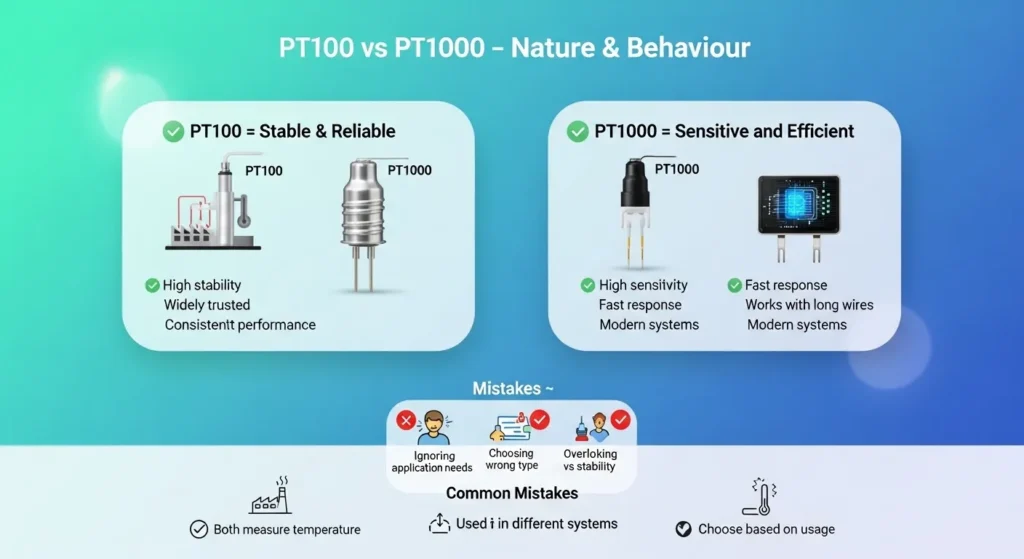
Nature of PT100
PT100 is stable. It is widely trusted. It suits industrial use.
Nature of PT1000
PT1000 is sensitive. It is efficient. It suits modern systems.
Why People Are Confused About Their Use
Both are RTD sensors. Names are similar. Both measure temperature. This creates confusion.
Table Showing Difference and Similarity
| Feature | PT100 | PT1000 | Similarity |
| Resistance | 100Ω | 1000Ω | Both RTD sensors |
| Sensitivity | Lower | Higher | Both measure temperature |
| Wiring Effect | High | Low | Both used in systems |
| Cost | Lower | Higher | Both used widely |
| Usage | Industrial | Modern systems | Both reliable |
Which Is Better in What Situation
When PT100 Is Better
PT100 is better for industrial setups. It is widely used. It works well in controlled environments.
When PT1000 Is Better
PT1000 is better for long cables. It reduces error. It suits modern electronics.
How the Keywords Are Used in Metaphors and Similes
PT100 metaphor:
Example: “PT100 is like a steady worker.”
PT1000 metaphor:
Example: “PT1000 is like a sharp observer.”
Connotative Meaning
PT100 – neutral
Example: “PT100 shows reliability.”
PT1000 – positive
Example: “PT1000 shows precision.”
Idioms or Proverbs Related to the Words
Measure twice, cut once
Example: Sensors like PT100 ensure accuracy.
Works in Literature
- Temperature Measurement Guide Engineering, 2012
- Sensors and Transducers Technical, 2015
- Industrial Instrumentation Academic, 2010
Movies Related to the Keywords
- The Imitation Game 2014, United States
- Ex Machina 2015, United States
- Transcendence 2014, United States
Frequently Asked Questions
1. What is the difference between PT100 and PT1000?
PT100 has 100Ω. PT1000 has 1000Ω.
2. Which is more accurate?
Both are accurate. PT100 is slightly more stable.
3. Which is better for long cables?
PT1000 is better.
4. Which is cheaper?
PT100 is cheaper.
5. Can both measure temperature?
Yes.
How Both Are Useful for Surroundings
Both measure temperature. They help in industries, labs, and homes. They improve safety and control.
Final Words for the Both
PT100 and PT1000 are useful sensors. Each has its role.
Conclusion
The difference between PT1000 andPT100 is based on resistance, sensitivity, and usage. PT100 uses 100 ohms at 0°C and is widely used in industrial environments due to its stability and reliability.
PT1000, with 1000 ohms at 0°C, offers higher sensitivity and performs better in systems with long wires, reducing measurement errors.
Both sensors are types of resistance temperature detectors and provide accurate temperature readings in different conditions.
PT100 is ideal for traditional industrial setups where precision and proven performance are required.
PT1000 is better for modern systems that need higher sensitivity and simpler wiring. The choice depends on the application, environment, and system design.
Understanding the difference between PT100 or PT1000 helps engineers and learners choose the right sensor. It also improves measurement accuracy and system efficiency in real world applications.
Discover More Articls!
Difference Between IPv4 and IPv6: Meaning and Networking Guide
Difference Between 1SS and 2SS With In 30 Seconds(2026)

labdiff.com is my English grammar comparison website where I simplify confusing words, spelling differences, and usage rules through clear explanations and examples. My goal is to help learners, writers, and students understand English easily and use correct grammar with confidence.