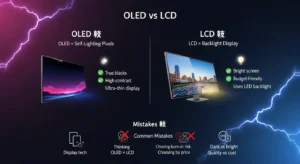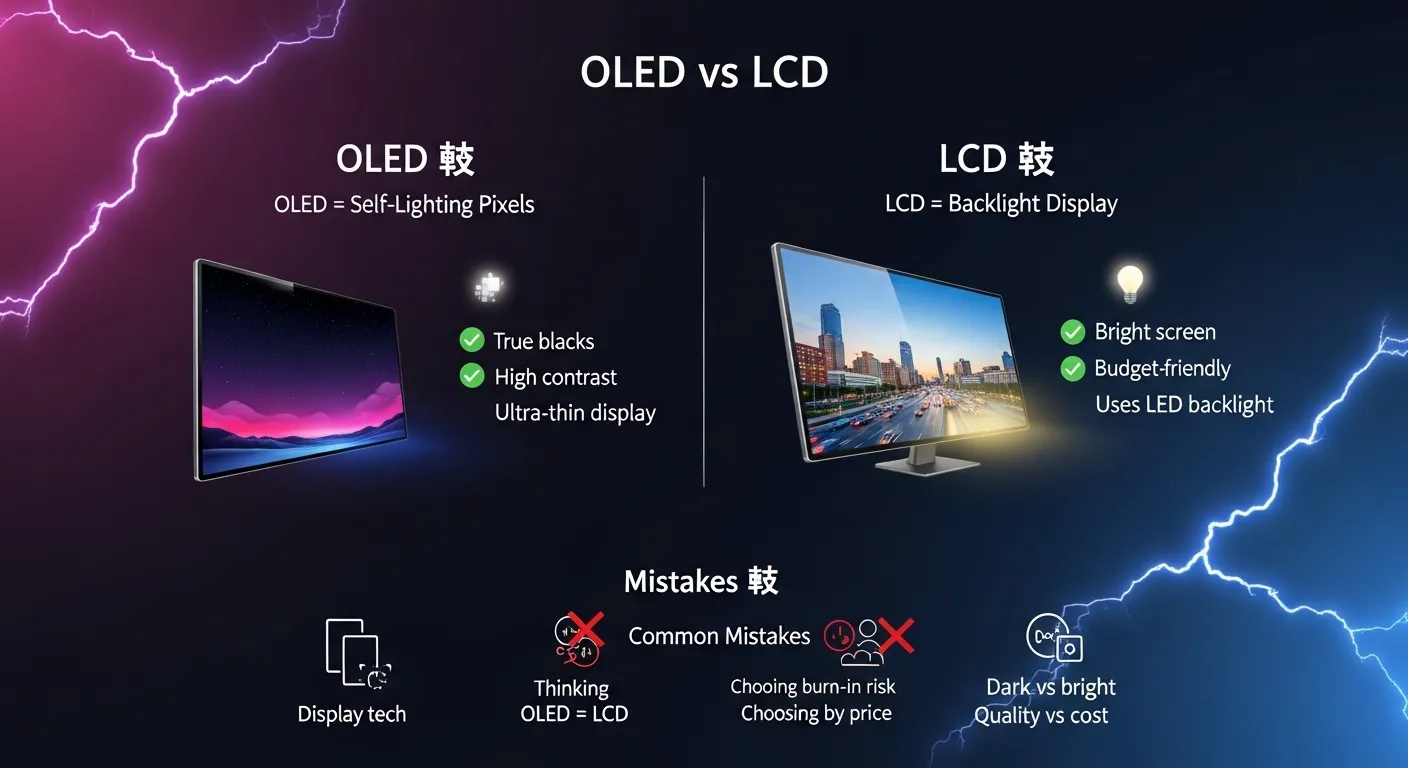
The difference between OLED vs LCD is simple. OLED screens use self lighting pixels, while LCD screens use a backlight to display images.
Imagine watching a movie at night. On an OLED screen, dark scenes look truly black because pixels turn off.
On an LCD screen, the black areas may look slightly gray because of the backlight. This real life example clearly explains the difference between OLED or LCD.
Many users search questions like “OLED vs LCD which is better,” “difference between OLED and LCD display,” and “OLED vs LED vs LCD.”
These queries show that the difference between LCD and OLED is important when buying TVs, phones, or monitors. Both technologies display images, but they work differently.
Understanding the difference between OLED and LCD helps users choose the right screen based on quality, budget, and usage.
Key Difference Between the Both
The main difference is lighting technology. OLED uses self emitting pixels, while LCD uses a separate backlight to illuminate the screen.
Why Their Difference Is Necessary for Learners and Experts
Understanding this difference is important for consumers and tech professionals. Buyers need to choose displays based on quality and cost.
Designers and engineers study these technologies to improve screens. In daily life, people use displays for work, entertainment, and communication.
Knowing the difference helps in selecting the best device and understanding how display technology works.
Pronunciation (US & UK)
| Term | US Pronunciation | UK Pronunciation |
| OLED | /ˈoʊlɛd/ | /ˈəʊlɛd/ |
| LCD | /ˌɛl siː ˈdiː/ | /ˌɛl siː ˈdiː/ |
Now that the basics are clear, let’s explore the detailed difference between OLED and LCD.
Difference Between the Keywords
1. Basic Technology
OLED uses organic light emitting diodes. LCD uses liquid crystals with backlight.
Example 1:
OLED pixels emit their own light.
Example 2:
LCD screens rely on LED backlight.
2. Picture Quality
OLED offers better contrast. LCD has good but lower contrast.
Example 1:
OLED shows deep blacks.
Example 2:
LCD shows lighter blacks.
3. Brightness
LCD can be brighter. OLED has moderate brightness.
Example 1:
LCD performs well in bright rooms.
Example 2:
OLED is ideal for dark environments.
4. Color Accuracy
OLED has richer colors. LCD has decent color quality.
Example 1:
OLED displays vibrant colors.
Example 2:
LCD displays standard colors.
5. Thickness
OLED screens are thinner. LCD screens are thicker.
Example 1:
OLED TVs are very slim.
Example 2:
LCD TVs are slightly bulky.
6. Power Consumption
OLED uses less power for dark images. LCD uses constant power.
Example 1:
OLED saves energy with dark content.
Example 2:
LCD uses similar power always.
7. Viewing Angles
OLED has wide viewing angles. LCD has limited angles.
Example 1:
OLED looks clear from any angle.
Example 2:
LCD colors fade from the side.
8. Lifespan
LCD generally lasts longer. OLED may degrade over time.
Example 1:
LCD screens have stable lifespan.
Example 2:
OLED pixels may wear out.
9. Cost
OLED is more expensive. LCD is more affordable.
Example 1:
OLED TVs cost more.
Example 2:
LCD TVs are budget friendly.
10. Burn in Risk
OLED may face burn in issues. LCD does not.
Example 1:
OLED may show image retention.
Example 2:
LCD avoids burn in problems.
Nature and Behaviour
Nature of OLED
OLED is advanced and flexible. It provides high contrast and deep blacks.
Nature of LCD
LCD is reliable and widely used. It offers good brightness and affordability.
Why People Are Confused About Their Use
Both are display technologies used in TVs and phones. Many people think they are the same. The confusion increases because LCD often uses LED backlighting, which is marketed differently.
Table Showing Difference and Similarity
| Feature | OLED | LCD | Similarity |
| Technology | Self lighting pixels | Backlight system | Both display images |
| Contrast | High | Moderate | Both used in screens |
| Thickness | Thin | Thicker | Both used in devices |
| Cost | Expensive | Affordable | Both vary by model |
| Usage | Premium devices | Common devices | Both widely used |
Which Is Better in What Situation
When OLED Is Better
OLED is better for watching movies, gaming, and high quality visuals. It offers deep blacks, better contrast, and wide viewing angles. It is ideal for users who want premium display quality.
When LCD Is Better
LCD is better for budget users and bright environments. It offers higher brightness and lower cost. It is suitable for everyday use like office work, TV watching, and general tasks.
How the Keywords Are Used in Metaphors and Similes
OLED metaphor:
Example: “Her ideas shine like an OLED display, clear and bright.”
LCD metaphor:
Example: “His approach is like an LCD, simple and reliable.”
Connotative Meaning
OLED – positive meaning
Example: “OLED represents premium quality.”
LCD – neutral meaning
Example: “LCD represents practicality.”
Idioms or Proverbs Related to the Words
Direct idioms are rare.
Clear as day
Example: The OLED screen looks clear as day.
Works in Literature
- Display Technology Fundamentals Technical Book, 2010
- Modern Electronics Academic Text, 2015
- Digital Imaging Systems Engineering Book, 2012
Movies Related to the Keywords
- The Social Network 2010, United States
- Steve Jobs 2015, United States
- Tron: Legacy 2010, United States
Frequently Asked Questions
1. What is the difference between OLED and LCD?
OLED uses self lighting pixels, while LCD uses a backlight.
2. Which is better for picture quality?
OLED provides better contrast and colors.
3. Is OLED more expensive?
Yes. It usually costs more than LCD.
4. Does OLED have burn in issues?
Yes. It can happen over time.
5. Which is better for bright rooms?
LCD performs better in bright environments.
How Both Are Useful for Surroundings
Both technologies are used in TVs, phones, and monitors. They support communication, entertainment, and work. They help people interact with digital content daily.
Final Words for the Both
OLED and LCD are important display technologies. Each has strengths and weaknesses based on usage.
Conclusion
The difference between OLED and LCD lies in how each display produces light and presents images. OLED uses self emitting pixels, which allows each pixel to turn on and off individually. This results in deep blacks, strong contrast, and a more immersive viewing experience.
On the other hand, LCD depends on a backlight, which makes it brighter and often more affordable, but slightly less precise in dark scenes.
Both technologies are widely used and serve different needs. OLED is suitable for users who want premium visual quality, especially for movies and gaming.
LCD is ideal for everyday use, especially in bright environments where higher brightness is useful. Cost also plays an important role, as LCD devices are usually more budget-friendly.
Understanding the difference between OLED and LCD helps users make better decisions when buying screens. It also improves knowledge of how modern display technology works.
In simple terms, OLED focuses on quality and contrast, while LCD focuses on brightness and affordability. Choosing the right option depends on personal needs, usage, and budget.
Discover more Articals
Difference Between Femboy and Transn
Difference Between Remote and Teleworka

James Whitmore. Labdiff.com is my english grammar comparision website. I explore the history and evolution of English words. I write detailed comparisons explaining why spellings change over time and how British and American English diverged. My articles add depth and credibility to grammar comparison topics.