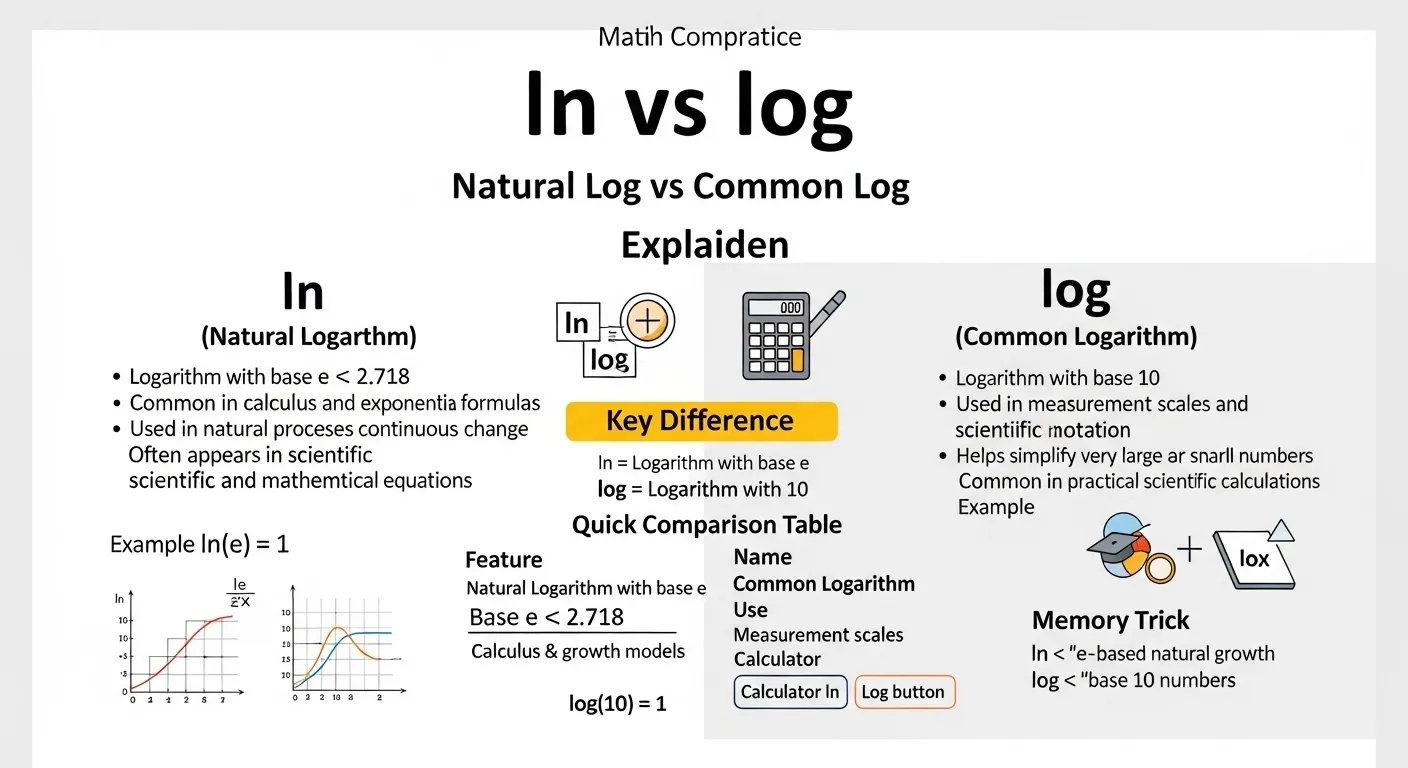
The difference betweenlog and ln is simple: ln is a logarithm with base e, while log is usually a logarithm with base 10.
Many students first notice this in mathematics class. A teacher writes ln(8) and log(8) on the board.
Both look similar. The results are not the same. One student once solved a growth equation using log instead of ln.
His answer became wrong. The formula required the natural logarithm. That small mistake showed why the difference between ln vs log matters.
In daily study and research, people search questions like “ln vs log calculator,” “log vs ln formula,” and “when to use ln instead of log.” These questions show the need to understand the difference between ln and log clearly.
Scientists, engineers, economists, and students use these functions to explain growth, decay, and measurement.
Learning the difference between ln or log helps avoid confusion and makes calculations accurate.
Key Difference Between the Both
The main difference is their base value.
- ln (natural logarithm) uses base e, where e ≈ 2.718.
- log (common logarithm) usually uses base 10.
Why Their Difference Is Necessary for Learners and Experts
Understanding this difference is important in many areas. Mathematics students meet these terms in algebra and calculus.
Scientists use ln in formulas describing natural growth and decay. Engineers use log when studying measurement scales such as sound intensity. Economists analyze financial growth using logarithmic functions.
If learners confuse ln and log, their answers may become incorrect. Experts rely on correct logarithmic forms to build models, study patterns, and make accurate calculations.
Knowledge of this concept helps people interpret numerical data clearly in research and education.
Pronunciation
| Term | US Pronunciation | UK Pronunciation |
| ln | /ˌɛl ˈɛn/ (ell en) | /ˌɛl ˈɛn/ |
| log | /lɔːg/ | /lɒg/ |
Now that the basics are clear, it is helpful to examine the difference between ln and log in detail.
Difference Between ln and log
1. Base Value
ln uses the base e.
log uses the base 10.
Example 1:
ln(e) = 1
Example 2:
log(10) = 1
2. Full Name
ln means natural logarithm.
log means common logarithm.
Example 1:
ln(4) represents natural logarithm of 4.
Example 2:
log(4) represents base 10 logarithm of 4.
3. Mathematical Relationship
ln connects directly with exponential function eˣ.
log connects with powers of 10.
Example 1:
ln(e²) = 2
Example 2:
log(10²) = 2
4. Use in Calculus
ln appears frequently in calculus formulas.
log appears less often in calculus.
Example 1:
Derivative of ln(x) = 1/x
Example 2:
Derivative of log(x) involves an extra constant.
5. Use in Scientific Measurement
log is widely used in measurement scales.
ln appears more in theoretical formulas.
Example 1:
Sound intensity scale uses log.
Example 2:
Radioactive decay equations often use ln.
6. Calculator Functions
Most calculators provide separate buttons.
Example 1:
Press ln to find natural logarithm.
Example 2:
Press log to calculate base 10 logarithm.
7. Appearance in Equations
ln is common in exponential growth equations.
log appears in base 10 transformations.
Example 1:
Population growth formula may include ln.
Example 2:
Scientific notation problems often use log.
8. Conversion Relationship
ln and log can convert into each other.
Example 1:
ln(x) = log(x) / log(e)
Example 2:
log(x) = ln(x) / ln(10)
9. Graph Shape
Both graphs increase slowly.
The rate differs due to different bases.
Example 1:
Graph of ln(x) rises gradually.
Example 2:
Graph of log(x) rises slightly slower.
10. Field of Application
ln is common in higher mathematics and physics.
log appears in practical measurements.
Example 1:
Chemistry formulas often include ln.
Example 2:
Earthquake magnitude uses log scale.
Nature and Behaviour
Nature of ln
ln reflects natural mathematical growth patterns. The base e appears naturally in calculus and exponential processes. It connects closely with continuous change.
Nature of log
log focuses on powers of ten. It helps simplify very large or very small numbers. Scientists use it to represent wide measurement ranges.
Why People Are Confused About Their Use
The symbols ln and log look similar. Many textbooks sometimes write “log” without mentioning the base. In mathematics courses it may mean base 10, while in advanced mathematics it may represent base e.
Calculators also place ln and log buttons close together. Beginners often assume they mean the same thing. This similarity creates confusion.
Table Showing Difference and Similarity
| Feature | ln | log | Similarity |
| Base | e (≈2.718) | 10 | Both logarithmic functions |
| Name | Natural logarithm | Common logarithm | Both measure exponent |
| Symbol | ln(x) | log(x) | Both simplify exponential expressions |
| Use | Calculus and growth models | Measurement scales | Both used in science |
| Calculator | ln button | log button | Both functions available |
Which Is Better in What Situation?
When ln is better
ln is useful in problems involving continuous growth or decay. Calculus formulas often include ln because it connects naturally with the constant e.
Population growth models, chemical reactions, and financial compounding sometimes require ln.
Students solving differential equations frequently encounter this function. Using ln in such situations keeps formulas simple and accurate.
When log is better
log works well when dealing with powers of ten. Scientists often use it in measurement scales. Sound intensity, earthquake magnitude, and scientific notation rely on base 10 logarithms.
In these contexts log helps represent very large or very small numbers clearly. Engineers and researchers often use log for data comparison and measurement analysis.
Metaphors and Similes
ln in metaphors
Example: “Her knowledge grew like ln(x), slowly but steadily.”
log in metaphors
Example: “His success increased like numbers on a log scale.”
Connotative Meaning
ln – neutral meaning
Example: “The researcher applied ln to analyze growth patterns.”
log – neutral meaning
Example: “The engineer used log values in measurement calculations.”
Idioms or Proverbs Related to the Words
Direct idioms are rare, but similar expressions appear.
Example proverb: “Small steps lead to big results.”
Sentence: Learning mathematics grows step by step like a logarithmic pattern.
Example saying: “Growth comes little by little.”
Sentence: Knowledge sometimes increases like values on a log scale.
Works in Literature Related to Logarithms
- The Joy of x Popular Mathematics, Steven Strogatz, 2012
- A Mathematician’s Apology Mathematical Essay, G. H. Hardy, 1940
- Mathematics and the Imagination Mathematics Writing, Edward Kasner, 1940
Movies Related to Mathematics Concepts
- A Beautiful Mind 2001, United States
- The Man Who Knew Infinity 2015, United Kingdom
- Hidden Figures 2016, United States
Frequently Asked Questions
1. Is ln the same as log?
No. ln uses base e, while log usually uses base 10.
2. Why do calculators have ln and log buttons?
They perform different logarithmic calculations.
3. When should ln be used instead of log?
ln is used in calculus and natural growth formulas.
4. Can ln be converted to log?
Yes. Mathematical formulas allow conversion between them.
5. Why do scientists use logarithms?
They simplify large numbers and explain growth patterns.
How Both Are Useful for Surroundings
Logarithmic functions help people understand many natural and scientific patterns. Sound levels, earthquake magnitude, and chemical reactions often rely on logarithmic calculations. ln explains natural growth patterns in biology and finance.
log helps represent measurement scales and scientific data. These tools make complex numerical relationships easier to study.
Final Words for the Both
ln and log are closely connected mathematical tools. Each has its own base and purpose. Understanding their difference improves accuracy in calculations and scientific reasoning.
Conclusion
The difference between ln and log mainly lies in their base values. ln uses the constant e, while log usually uses base 10.
This small difference leads to different results in equations. ln appears often in calculus and growth models. log is widely used in measurement scales and scientific notation.
Students often confuse them because the symbols look similar. Learning their roles and applications makes mathematical work clearer and more reliable.
Discover More Articals!
📊 Difference Between Correlation and Covariance
💰 Difference Between AML and KYC: Simple and Clear Guide
🧘 Difference Between Yoga and Meditation

James Whitmore. Labdiff.com is my english grammar comparision website. I explore the history and evolution of English words. I write detailed comparisons explaining why spellings change over time and how British and American English diverged. My articles add depth and credibility to grammar comparison topics.