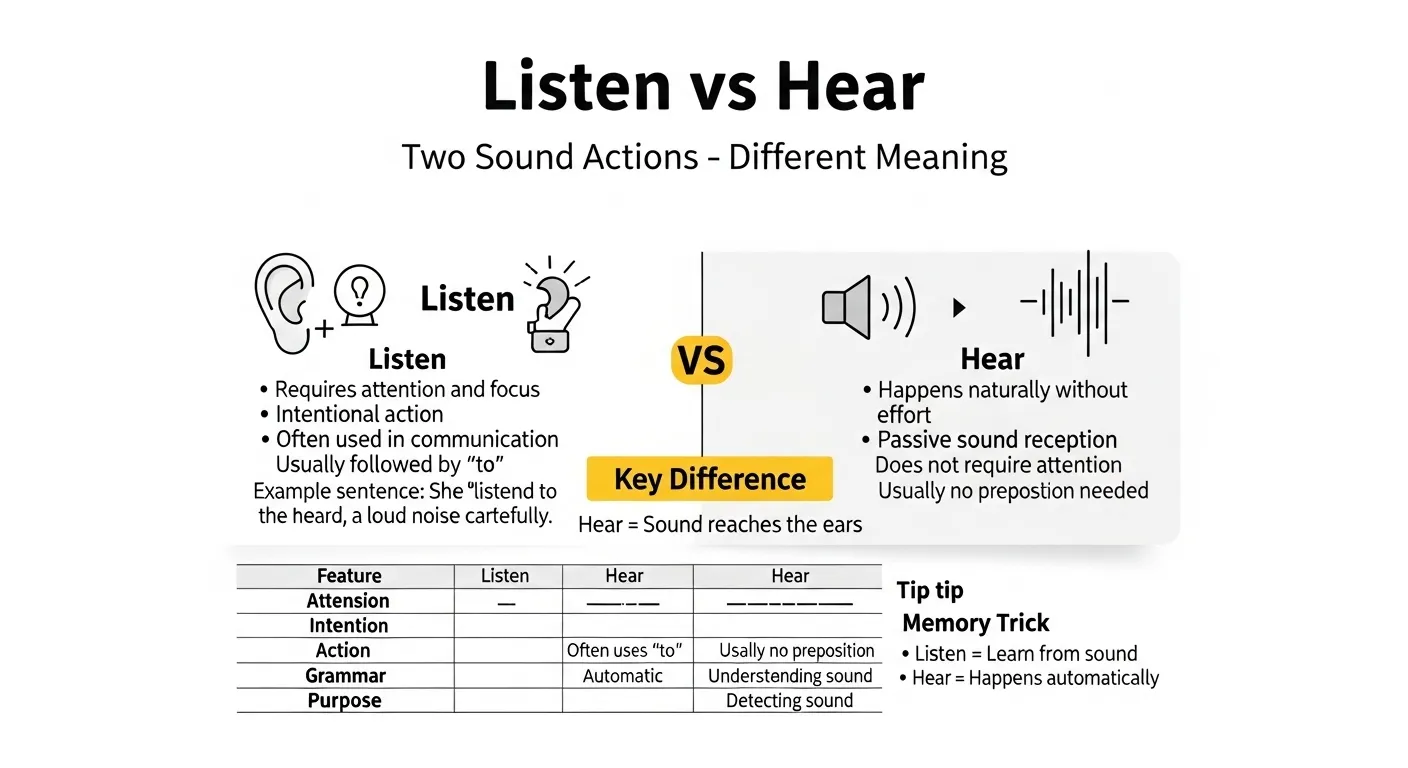
The difference between listen and hear is simple. Hear means to receive sound naturally, while listen means to pay attention to sound intentionally. Imagine a student sitting in a classroom.
The teacher is explaining an important topic. The student can hear the teacher’s voice because sound reaches his ears.
However, if he focuses carefully on every word and tries to understand the explanation, then he is listening. This everyday situation explains the difference between listen vs hear clearly.
Many learners search questions like “listen vs hear meaning,” “when to use listen and hear,” and “examples of listen and hear in sentences.” These searches show why the difference between listen or hear is important in English learning. Both words relate to sound, but their meanings and usage are different.
Understanding the difference between listen and hear helps learners communicate clearly and avoid common language mistakes.
Key Difference Between the Both
The main difference is attention. Hearing happens naturally without effort, while listening requires focus and intention.
Why Their Difference Is Necessary for Learners and Experts
Understanding this difference is important for communication and language learning. Teachers, students, and writers use these words to express different actions related to sound.
In conversations, listening shows attention and respect. In education, listening skills help students understand lessons clearly.
Professionals in fields such as counseling, teaching, and broadcasting also rely on strong listening abilities. Recognizing the difference helps people use the correct word in speaking and writing.
Pronunciation (US & UK)
| Term | US Pronunciation | UK Pronunciation |
| Listen | /ˈlɪsən/ | /ˈlɪsən/ |
| Hear | /hɪr/ | /hɪə/ |
Now that the basic idea is clear, the next section explains the difference between listen and hear in detail.
Difference Between the Keywords
1. Meaning
Listen means to pay attention to sound. Hear means to receive sound through the ears.
Example 1:
She listened carefully to the teacher’s instructions.
Example 2:
He heard a loud noise outside.
2. Level of Attention
Listening requires focus and concentration. Hearing does not require attention.
Example 1:
The student listened to the lecture attentively.
Example 2:
She heard music playing in the background.
3. Intentional Action
Listening is a deliberate action. Hearing happens automatically.
Example 1:
He listened to the podcast during his trip.
Example 2:
She heard a bird singing in the morning.
4. Use in Communication
Listening plays an important role in conversations. Hearing simply indicates that sound reached the ears.
Example 1:
Good leaders listen to their team members.
Example 2:
I heard someone calling my name.
5. Grammar Use
Listen often requires the preposition “to.” Hear usually does not require a preposition.
Example 1:
She listened to the radio.
Example 2:
He heard the announcement.
6. Role in Learning
Listening is an important skill for understanding lessons. Hearing alone does not guarantee understanding.
Example 1:
Students must listen to the teacher carefully.
Example 2:
He heard the lecture but did not understand it.
7. Control Over Action
People can choose to listen. Hearing cannot always be controlled.
Example 1:
She listened to the interview with interest.
Example 2:
He heard the thunder during the storm.
8. Emotional Connection
Listening can show empathy or care. Hearing does not show emotion.
Example 1:
A good friend listens to problems patiently.
Example 2:
He heard the news on television.
9. Use in Media
Listening is used for music and audio programs. Hearing refers to noticing sounds.
Example 1:
She listens to music every evening.
Example 2:
I heard a strange sound in the hallway.
10. Context of Use
Listening often appears in active communication contexts. Hearing appears in passive sound detection.
Example 1:
They listened to the speech carefully.
Example 2:
She heard footsteps behind her.
Nature and Behaviour
Nature of Listen
Listening is an active action. It involves attention, focus, and understanding.
Nature of Hear
Hearing is a natural ability. It occurs automatically when sound reaches the ears.
Why People Are Confused About Their Use
Both words relate to sound and appear in similar situations. Many learners assume they mean the same thing. However, one describes passive sound reception, while the other describes active attention to sound.
Table Showing Difference and Similarity
| Feature | Listen | Hear | Similarity |
| Action type | Active | Passive | Both relate to sound |
| Attention | Requires focus | No focus needed | Both involve ears |
| Control | Intentional | Automatic | Both describe sound perception |
| Grammar | Often uses “to” | Usually no preposition | Both used in communication |
| Purpose | Understanding | Sound detection | Both used in language |
Which Is Better in What Situation
When listen is better
Listen is better when someone needs to pay attention to sound or understand information. In conversations, listening carefully helps people communicate clearly and avoid misunderstandings. Students also listen to lectures to gain knowledge and follow instructions.
When hear is better
Hear is better when someone simply notices a sound without focusing on it. For example, a person may hear a phone ringing, thunder outside, or music playing in the background. In these situations the sound reaches the ears naturally.
How the Keywords Are Used in Metaphors and Similes
Listen metaphor
Example: “A wise leader listens like a patient teacher.”
Hear metaphor
Example: “He heard the news like a distant echo.”
Connotative Meaning
Listen – positive tone
Example: “She listened kindly to her friend’s worries.”
Hear – neutral tone
Example: “He heard the announcement on the radio.”
Idioms or Proverbs Related to the Words
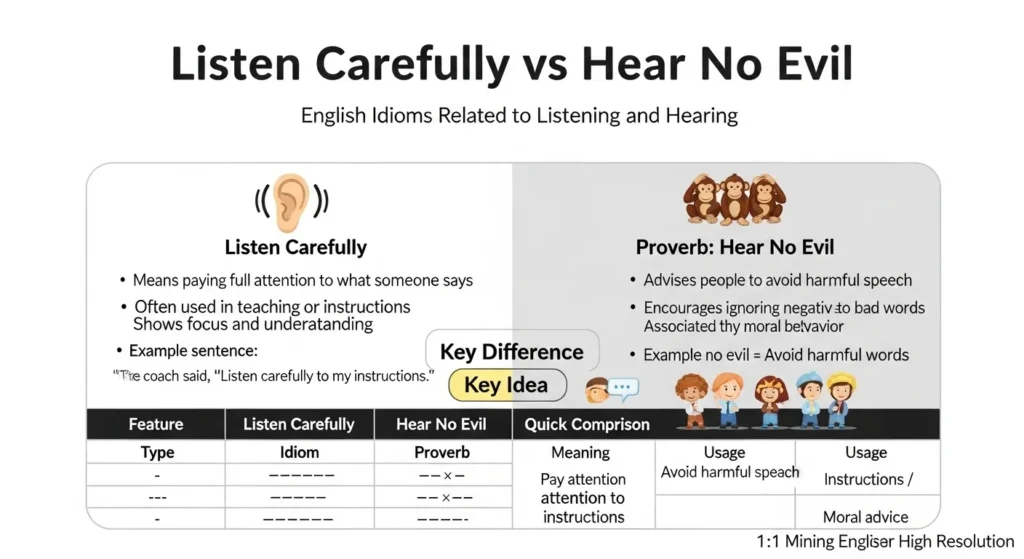
Idiom: Listen carefully
Example: The coach said, “Listen carefully to my instructions.”
Proverb: Hear no evil
Example: The saying advises people to avoid harmful speech.
Works in Literature
- How to Listen Communication Guide, Oscar Trimboli, 2022
- On Becoming a Person Psychology Writing, Carl Rogers, 1961
- The Art of Listening Communication Studies, Erich Fromm, 1957
Movies Related to the Keywords
- The Sound of Music 1965, United States
- A Quiet Place 2018, United States
- Bird Box 2018, United States
Frequently Asked Questions
1. What is the main difference between listen and hear?
Listening requires attention, while hearing happens naturally.
2. Can someone hear without listening?
Yes. A person can hear sounds without focusing on them.
3. Do we say listen music or listen to music?
The correct form is “listen to music.”
4. Why is listening important in communication?
It helps people understand messages clearly.
5. Can listening improve learning?
Yes. Careful listening helps students understand lessons better.
How Both Are Useful for Surroundings
Both abilities help people understand the environment around them. Hearing alerts people to important sounds such as alarms or warnings. Listening helps people communicate, learn new information, and enjoy music or conversations.
Final Words for the Both
Listen and hear are closely related but not identical. One involves active attention, while the other describes natural sound reception.
Conclusion
The difference between listen and hear mainly lies in attention and intention. Hearing occurs naturally when sound reaches the ears, while listening requires focus and understanding. Both words play important roles in communication and daily life.
People hear sounds constantly, but effective listening allows them to interpret messages and respond properly.
By understanding the difference between listen and hear, learners can use these words correctly in speaking and writing.
Discover More Articals!
🏍️ Difference Between R1 and R1M
Difference Between Blu ray and DVD: Storage and Technology Explained
Difference Between Renounce and Denounce

labdiff.com is my English grammar comparison website where I simplify confusing words, spelling differences, and usage rules through clear explanations and examples. My goal is to help learners, writers, and students understand English easily and use correct grammar with confidence.