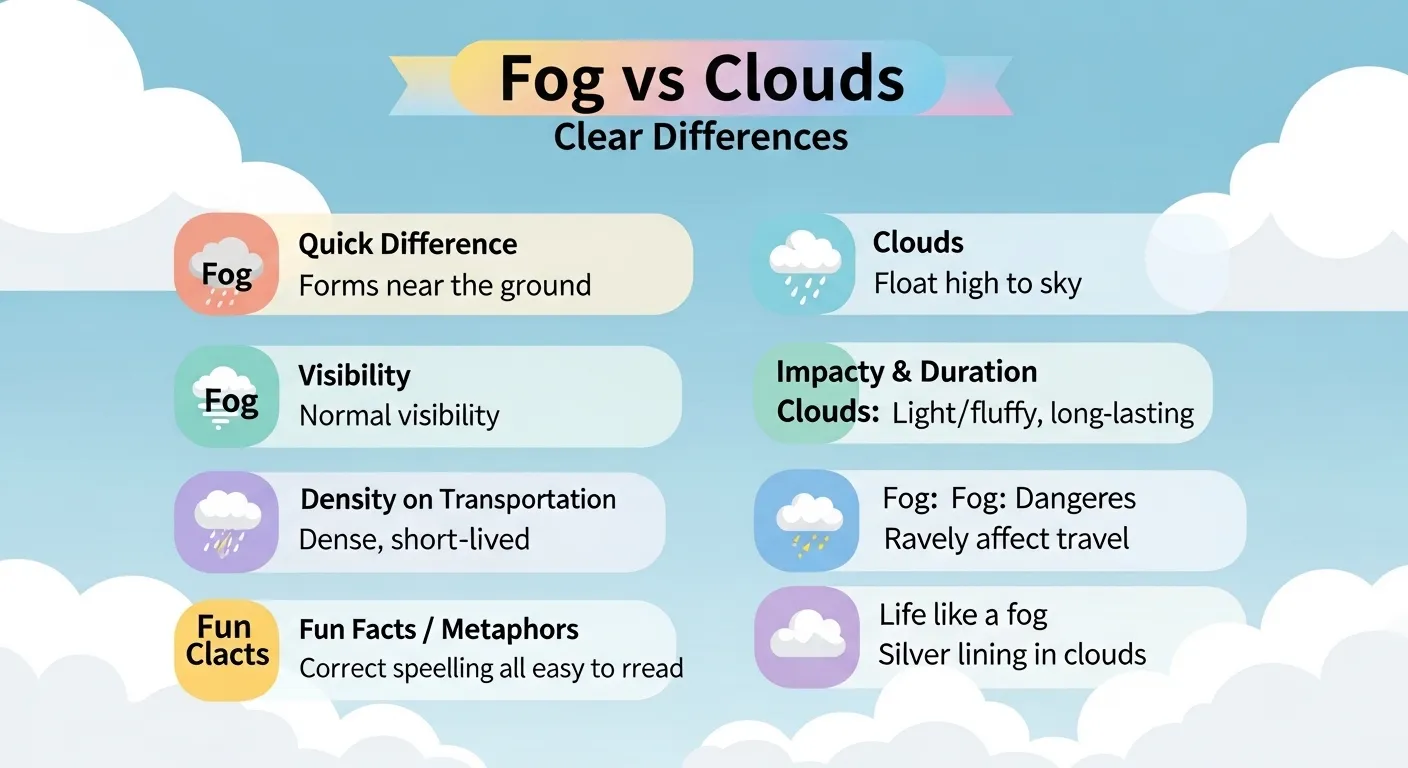
Fog and clouds are often confused, but the difference between fog and clouds is simple: fog forms near the ground, while clouds float high in the sky.
Imagine waking up early and seeing your town wrapped in a thick white mist that is fog. Later, when you look up and see fluffy white masses, those are clouds.
Many people mix them up, but knowing the difference between fog or clouds is important for pilots, travelers, and weather enthusiasts.
Walking in a foggy morning or watching clouds drift helps you connect with nature while understanding the difference between fog and clouds clearly.
Key Difference Between Clouds and Fog
The main difference is simple: fog touches the ground, while clouds float above. Think of fog as a “low hanging cloud,” but clouds always stay higher in the sky.
Why Knowing Their Difference Matters
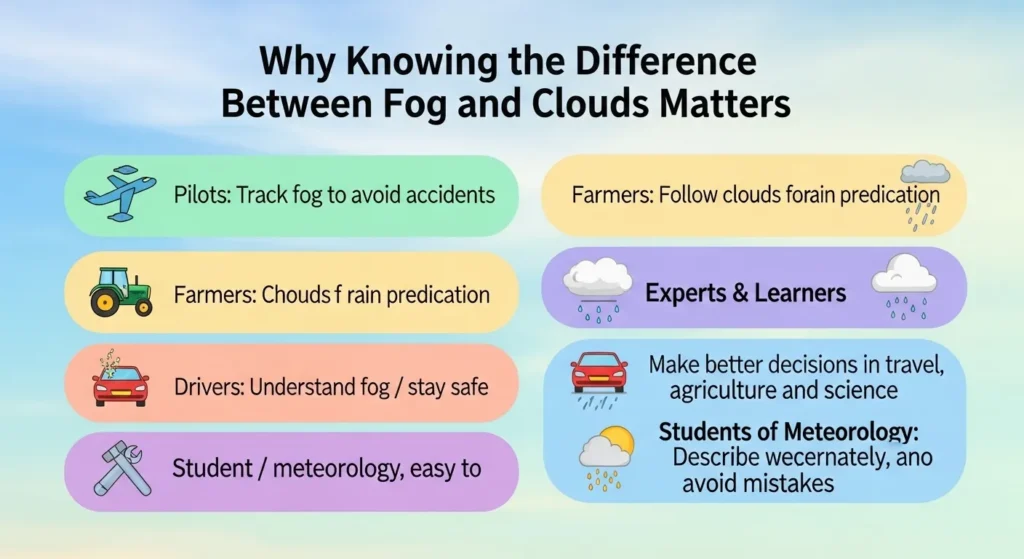
Knowing the difference between fog and clouds is crucial. Pilots need to track fog to avoid accidents. Farmers follow clouds for rain prediction. Drivers must understand fog to stay safe.
Experts and learners benefit by making better decisions in travel, agriculture, and science. Students of meteorology can describe weather accurately and avoid mistakes.
Pronunciation
- Fog US: /fɑːɡ/, UK: /fɒɡ/
- Clouds US & UK: /klaʊdz/
Let’s dive deeper into the main differences.
: Difference Between Fog and Clouds
Here are 10 key differences with examples:
- Location
- Fog: Forms near the ground.
- Example: The city streets were covered in fog.
- Example: Drivers slowed down because of dense fog.
- Example: The city streets were covered in fog.
- Clouds: Float high in the sky.
- Example: Puffy clouds filled the blue sky.
- Example: The airplane flew above the clouds.
- Example: Puffy clouds filled the blue sky.
- Fog: Forms near the ground.
- Visibility
- Fog: Reduces visibility.
- Example: Fog made it hard to see the road.
- Example: The park was almost invisible in thick fog.
- Example: Fog made it hard to see the road.
- Clouds: Do not affect ground visibility.
- Example: Clouds blocked the sun but walking was easy.
- Example: The city was clear under cloudy skies.
- Example: Clouds blocked the sun but walking was easy.
- Fog: Reduces visibility.
- Formation Height
- Fog: Low altitude near the ground.
- Clouds: High altitude above the surface.
- Fog: Low altitude near the ground.
- Density
- Fog: Usually denser and thicker.
- Clouds: Can be light and fluffy.
- Fog: Usually denser and thicker.
- Duration
- Fog: Short-lived, disappears with sunlight.
- Clouds: Can last hours or days.
- Fog: Short-lived, disappears with sunlight.
- Impact on Transportation
- Fog: Dangerous for driving, flying, sailing.
- Clouds: Rarely affect movement.
- Fog: Dangerous for driving, flying, sailing.
- Appearance
- Fog: Misty blanket covering the area.
- Clouds: Clusters or streaks in the sky.
- Fog: Misty blanket covering the area.
- Water Content
- Fog: Tiny water droplets near the ground.
- Clouds: Water droplets or ice crystals high in the atmosphere.
- Fog: Tiny water droplets near the ground.
- Temperature Relation
- Fog: Forms in cooler temperatures.
- Clouds: Forms in various temperatures at different heights.
- Fog: Forms in cooler temperatures.
- Human Perception
- Fog: Seen as mysterious or eerie.
- Clouds: Seen as relaxing, scenic, or inspiring.
Nature and Behavior
- Fog: Low-hanging, slow-moving, disappears with sunlight.
- Clouds: High-floating, shape-changing, may produce rain or storms.
Why People Are Confused
Both are made of water droplets. Fog is basically a cloud at ground level, causing confusion.
🌫️ Fog vs Clouds: Common Questions People Ask
Many people search questions like fog vs clouds, what is the difference between fog and clouds, and are fog and clouds the same thing because both look similar.
The simple answer is: fog is a cloud near the ground, while clouds stay in the sky.
Some also ask:
- Is fog clouds?
Fog is technically a type of cloud, but it forms at ground level. - What’s the difference between a cloud and fog?
The main difference is height. Fog touches the ground, while clouds float above. - Difference between fog and cloud / fog and cloud difference
Fog reduces visibility and affects travel, while clouds usually do not affect visibility on the ground. - Difference between cloudy and foggy
Cloudy means the sky is covered with clouds, but you can still see clearly.
Foggy means visibility is reduced due to dense moisture near the ground. - Fog cloud meaning
This term is sometimes used informally to describe fog as a low-level cloud.
👉 In simple terms:
Fog = ground-level cloud
Clouds = sky-level formations
Comparison Table
| Feature | Fog | Clouds | Similarity |
| Location | Near ground | High in sky | Both made of water droplets |
| Visibility | Low | Normal | Both indicate weather |
| Formation | Low altitude | High altitude | Both form from condensation |
| Density | Dense | Light or fluffy | Both contain moisture |
| Duration | Short-lived | Long-lasting | Both change shape |
| Temperature | Cooler areas | Various altitudes | Both respond to temperature |
| Impact | High on transport | Low impact | Both influence environment |
Which Is Better in What Situation?
Fog: Creates calm, mysterious photography or movies. Signals cool, moist conditions, and alerts for safe travel.
Clouds: Predict weather, guide agriculture, and provide scenic beauty. Inspire poetry, art, and outdoor activities.
Use in Metaphors and Similes
- Fog: “Life was like a fog, unclear and confusing.”
- Clouds: “Her thoughts drifted like clouds across the sky.”
Connotative Meaning
- Fog: Neutral to negative “Fog of doubt”
- Clouds: Neutral to positive “Silver lining in the clouds”
Idioms or Proverbs
- Fog: “In a fog” confused or unaware.
- Clouds: “Every cloud has a silver lining” hope in trouble.
Works in Literature
- “The Fog” James Herbert, 1975 (Horror)
- “Clouds” Percy Bysshe Shelley, 1820 (Poetry)
Movies Related to Keywords
- The Fog 1980, USA (Horror)
- Clouds 2020, USA (Biography/Drama)
Frequently Asked Questions
- Is fog a cloud? Yes, a cloud at ground level.
- Do clouds reduce visibility? No, they are high in the sky.
- Can fog turn into clouds? Fog can rise and merge with clouds.
- Are fog and mist the same? Mist is lighter, fog is denser.
- Which is safer for driving? Clouds are safe; fog is hazardous.
How Both Are Useful for Surroundings
Fog cools the air and adds moisture. Clouds bring rain, protect from sun, and regulate temperature. Both maintain ecological balance.
Final Words
Knowing the difference between fog and clouds improves safety, learning, and appreciation of nature. Both have unique roles in weather and culture.
Conclusion
The difference between fog and clouds is mostly location and visibility. Fog forms near the ground, reducing sight and adding mystery, while clouds float high, decorating the sky.
Knowing their difference is essential for travelers, farmers, students, and nature lovers.
Both impact weather, ecology, and culture, inspiring art, literature, and safety decisions.
Recognizing fog and clouds helps in understanding weather patterns, appreciating nature, and making informed decisions. Next time you see fog or clouds, you will know their role and enjoy their beauty.
Discover More Posts!
📘 Difference Between Are and Our: Clear and Simple Guide
🛠️ Difference Between Steel and Metal: Simple Guide

labdiff.com is my English grammar comparison website where I simplify confusing words, spelling differences, and usage rules through clear explanations and examples. My goal is to help learners, writers, and students understand English easily and use correct grammar with confidence.