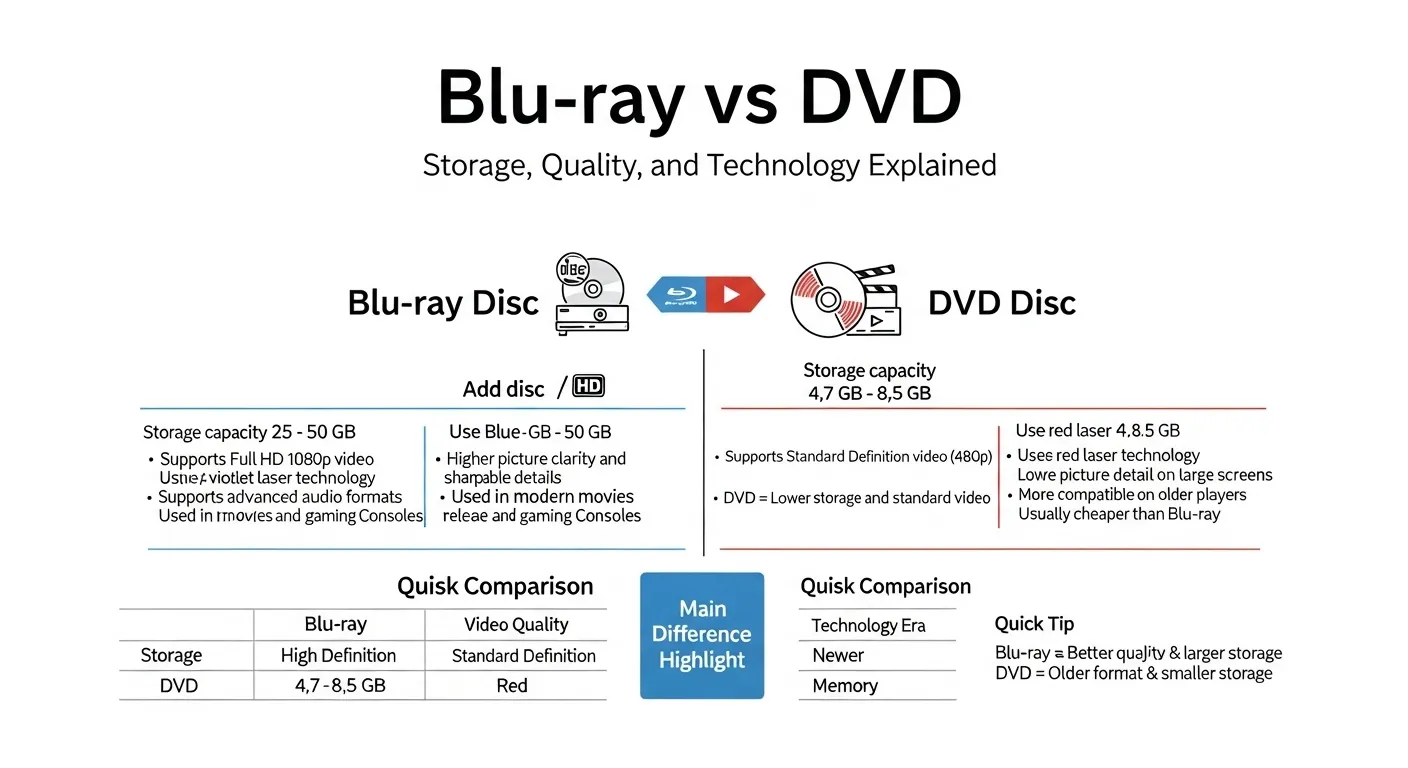
Blu ray discs store more data and support high definition video, while DVDs store less and usually provide standard definition video.
The difference between Blu ray and DVD is mainly about storage capacity, video quality, and the laser technology used to read the discs. Imagine a person watching an old movie collection at home. First they play the DVD version of a film.
The picture looks normal on the screen. Then they try the Blu ray version of the same movie. Suddenly the image becomes clearer and sharper. C
olors look richer and details appear stronger. This small experience explains the difference between Blu ray or DVD in everyday life.
Many people search questions like “Blu ray vs DVD quality,” “is Blu ray better than DVD,” and “Blu ray vs DVD storage size.”
These questions show why understanding the difference between Blu ray vs DVD is helpful.
Both discs store movies, games, and videos. However, their technology and performance are different.
Knowing the difference between Blu ray and DVD helps viewers choose the right format for watching movies or storing media files.
Key Difference Between the Both
The biggest difference is data storage and video resolution. Blu ray discs can store far more data and support high definition video, while DVDs store less data and usually provide standard definition video.
Why Their Difference Is Necessary for Learners and Experts
Understanding this difference is useful in many areas. Film producers release movies in formats that match modern display technology.
Media students study optical discs to understand digital storage systems. Technology professionals analyze formats when designing players and media devices.
Home users also benefit because they can choose a disc format that works best with their television and player.
Pronunciation (US & UK)
| Term | US Pronunciation | UK Pronunciation |
| Blu ray | /ˈbluː reɪ/ | /ˈbluː reɪ/ |
| DVD | /ˌdiː viː ˈdiː/ | /ˌdiː viː ˈdiː/ |
Now that the basic idea is clear, it is easier to explore the detailed difference between Blu ray and DVD.
Difference Between the Keywords
1. Storage Capacity
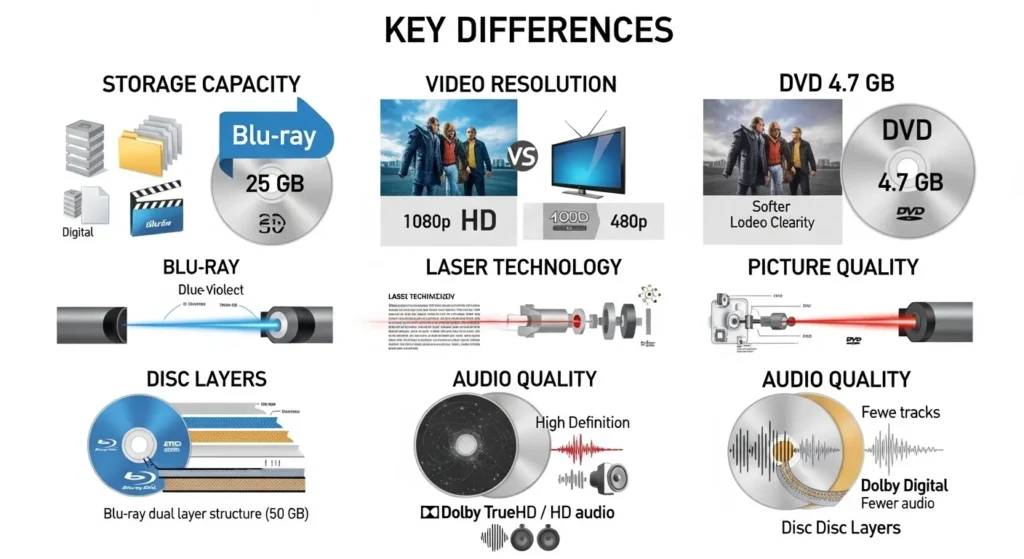
Blu ray discs hold much more data than DVDs.
Example 1:
A single layer Blu ray disc stores about 25 GB.
Example 2:
A single layer DVD stores about 4.7 GB.
2. Video Resolution
Blu ray supports high definition video. DVD supports standard definition.
Example 1:
Blu ray movies often display 1080p resolution.
Example 2:
DVD movies usually display 480p resolution.
3. Laser Technology
Blu ray uses a blue violet laser. DVDs use a red laser.
Example 1:
Blu ray lasers read smaller data tracks.
Example 2:
DVD lasers read wider tracks.
4. Picture Quality
Blu ray provides sharper images than DVD.
Example 1:
Blu ray shows clear textures and details.
Example 2:
DVD images can appear softer on large screens.
5. Audio Quality
Blu ray supports advanced sound formats.
Example 1:
Blu ray discs may include Dolby TrueHD.
Example 2:
DVD usually uses Dolby Digital audio.
6. Disc Layers
Blu ray dual layer discs hold more storage.
Example 1:
Dual layer Blu ray holds about 50 GB.
Example 2:
Dual layer DVD holds about 8.5 GB.
7. Player Compatibility
Blu ray discs require Blu ray players.
Example 1:
A Blu ray player can play Blu ray and DVD discs.
Example 2:
A DVD player cannot play Blu ray discs.
8. Cost
Blu ray discs usually cost more.
Example 1:
New movies often release in Blu ray at higher prices.
Example 2:
DVD versions are usually cheaper.
9. Use in Gaming
Modern gaming systems use Blu ray discs.
Example 1:
Many console games come on Blu ray.
Example 2:
Older game consoles used DVD discs.
10. Technology Era
DVD appeared earlier than Blu ray.
Example 1:
DVD technology became common in the late 1990s.
Example 2:
Blu ray became popular in the mid 2000s.
Nature and Behaviour
Nature of Blu ray
Blu ray focuses on high definition video and large storage. It suits modern televisions and advanced home entertainment systems.
Nature of DVD
DVD focuses on basic media storage and wide compatibility with older devices.
Why People Are Confused About Their Use
Both discs look almost identical in size and shape. Their names are also similar. Many people think they work in the same players. This similarity often creates confusion.
Table Showing Difference and Similarity
| Feature | Blu ray | DVD | Similarity |
| Laser | Blue violet | Red | Both optical discs |
| Storage | 25–50 GB | 4.7–8.5 GB | Both store media |
| Video Quality | High definition | Standard definition | Both play movies |
| Technology | Newer | Older | Same disc shape |
| Player | Blu ray player required | DVD player required | Home entertainment use |
Which Is Better in What Situation
Blu ray in modern viewing
Blu ray is better when viewers want clearer pictures and stronger sound. Modern televisions display Blu ray movies with rich color and sharp details.
DVD for simple playback
DVD works well when affordability and compatibility are important. Many older players and laptops support DVD discs.
How the Keywords Are Used in Metaphors and Similes
Blu ray metaphor
Example: “Her presentation was as clear as Blu ray quality.”
DVD metaphor
Example: “The memory felt like an old DVD, still valuable but less clear.”
Connotative Meaning
Blu ray – positive tone
Example: “The documentary appeared in Blu ray clarity.”
DVD – neutral tone
Example: “The training videos were stored on DVD.”
Idioms or Proverbs Related to the Words
Direct idioms about these formats are rare.
Proverb: Old is gold
Example: Many collectors believe DVDs remain valuable because they preserve classic films.
Proverb: Quality over quantity
Example: Blu ray often represents quality over quantity in movie collections.
Works in Literature
- The Film Experience Film Studies, Timothy Corrigan, 2009
- Understanding Movies Film Theory, Louis Giannetti, 1972
- Digital Video and HD Media Technology, Charles Poynton, 2003
Movies Released on Blu ray and DVD
- Avatar 2009, United States
- The Dark Knight 2008, United States
- Inception 2010, United States
Frequently Asked Questions
1. Is Blu ray better than DVD?
Yes. Blu ray usually provides better picture and sound quality.
2. Can a DVD player play Blu ray discs?
No. Blu ray discs require a Blu ray player.
3. Why does Blu ray store more data?
Its laser technology reads smaller data tracks.
4. Are DVDs still used today?
Yes. Many people still use DVDs for movies and storage.
5. Can Blu ray players play DVDs?
Yes. Most Blu ray players support DVD playback.
How Both Are Useful for Surroundings
Both formats help preserve entertainment and educational material. Schools sometimes use DVDs to show learning videos. Film collectors often store movies in Blu ray to keep higher picture quality.
Final Words for the Both
Blu ray and DVD represent two stages in optical disc technology. Each format serves different needs depending on quality and compatibility.
Conclusion
The difference between Blu ray and DVD mainly involves storage capacity, video resolution, and laser technology. Blu ray discs provide sharper images, stronger audio, and larger storage space.
DVDs offer simpler playback and lower cost. Both formats have played an important role in home entertainment and digital media storage.
Even though newer technologies continue to appear, Blu ray and DVD remain useful for movie collections and media distribution.
Understanding the difference between Blu ray and DVD helps viewers select the format that best matches their devices and viewing preferences.
Discover More Articals!
💰 Difference Between AML and KYC: Simple and Clear Guide
🧘 Difference Between Yoga and Meditation
📊 Difference Between Correlation and Covariance

labdiff.com is my English grammar comparison website where I simplify confusing words, spelling differences, and usage rules through clear explanations and examples. My goal is to help learners, writers, and students understand English easily and use correct grammar with confidence.