The difference between are and our is that “are” is a verb, while “our” shows possession.
The difference between are and our is simple. “Are” is a verb. “Our” shows something belongs to us.
A child once wrote, “Our going to school.” The teacher corrected him and said, “We are going to school.” The class understood the mistake.
The difference between are and our may look small, but it changes the meaning of a sentence. Many learners mix them up because they sound alike.
This confusion is common in writing and speech. When students understand the difference between are and our, they write better sentences.
Clear grammar builds confidence. If you know the difference between are and our, your English becomes stronger and more correct.
🔑 Key Difference Between Are and Our
- Are → A verb (form of “be”)
- Our → A possessive adjective (shows ownership)
Example:
- We are happy.
- This is our classroom.
🌍 Why Is It Important to Know the Difference?
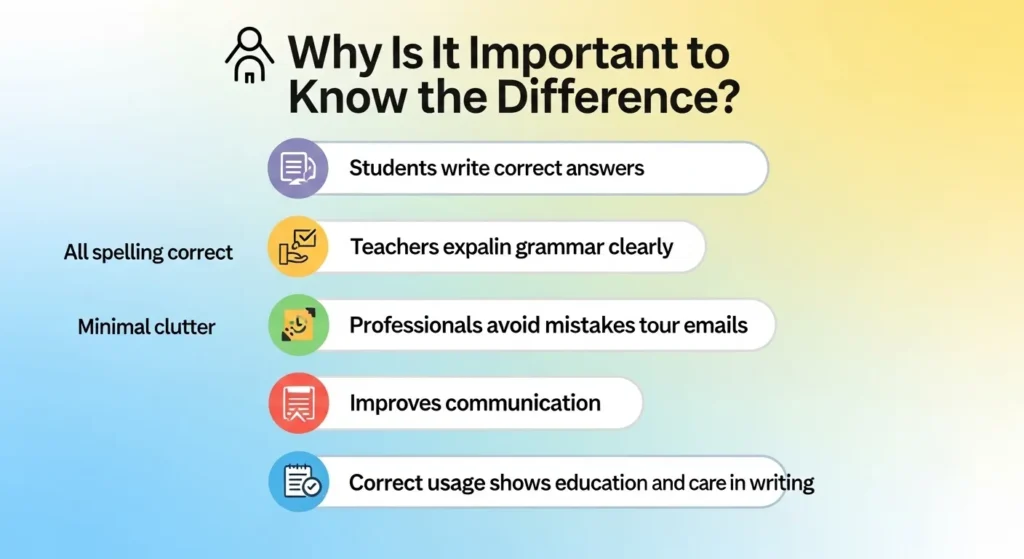
Learning the difference helps everyone.
- Students write correct answers.
- Teachers explain grammar clearly.
- Professionals avoid mistakes in emails.
- Good grammar builds respect.
- It improves communication skills.
Correct usage shows education and care in writing.
🔊 Pronunciation (US & UK)
- Are
- US: /ɑr/
- UK: /ɑː/
- US: /ɑr/
- Our
- US: /aʊər/
- UK: /aʊə/
- US: /aʊər/
They sound similar, but they are not the same.
Now let us understand the full difference in detail.
📖 Difference Between Are and Our
1️⃣ Part of Speech
Are
It is a verb.
Examples:
- They are friends.
- You are late.
Our
It is a possessive adjective.
Examples:
- Our house is big.
- Our teacher is kind.
2️⃣ Function in a Sentence
Are
Shows state or condition.
Examples:
- We are ready.
- They are strong.
Our
Shows ownership.
Examples:
- Our books are new.
- Our team won.
3️⃣ Position in a Sentence
Are
Comes after the subject.
Examples:
- We are students.
- They are busy.
Our
Comes before a noun.
Examples:
- Our school is clean.
- Our friends are here.
4️⃣ Meaning
Are
Means “to be.”
Examples:
- These are apples.
- You are my friend.
Our
Means “belonging to us.”
Examples:
- Our apples are sweet.
- Our family is happy.
5️⃣ Use in Questions
Are
Can start a question.
Examples:
- Are you ready?
- Are they coming?
Our
Cannot start a question alone.
Examples:
- Is this our bag?
- Are these our seats?
6️⃣ Tense
Are
Present tense form of “be.”
Examples:
- We are learning.
- They are playing.
Our
Has no tense.
Examples:
- Our lesson is easy.
- Our room is clean.
7️⃣ Grammar Role
Are
Helps complete a sentence.
Examples:
- You are smart.
- They are helpful.
Our
Describes a noun.
Examples:
- Our dog is friendly.
- Our car is blue.
8️⃣ Common Mistakes
Wrong: Our going home.
Correct: We are going home.
Wrong: Are house is big.
Correct: Our house is big.
9️⃣ Agreement with Subject
Are
Used with plural subjects and “you.”
Examples:
- They are doctors.
- You are correct.
Our
Same form for singular and plural nouns.
Examples:
- Our teacher is kind.
- Our teachers are kind.
🔟 Formal Writing Use
Are
Used in reports and statements.
Examples:
- We are pleased.
- The students are ready.
Our
Used to show group belonging.
Examples:
- Our company is growing.
- Our project is complete.
🌿 Nature and Behavior
Are connects the subject with information. It is active in grammar.
Our shows belonging. It builds a feeling of unity.
❓ Why Do People Get Confused?
- They sound alike.
- Fast speech makes them unclear.
- Spelling looks close.
- Learners confuse homophones.
Practice removes confusion.
📊 Table of Difference and Similarity
| Feature | Are | Our |
| Type | Verb | Possessive adjective |
| Meaning | To be | Belonging to us |
| Position | After subject | Before noun |
| Used in Questions | Yes | No |
| Tense | Present | No tense |
| Similarity | Both common English words | Both common English words |
🏆 Which Is Better in What Situation?
When to Use “Are”
Use “are” when talking about a state or condition. It is needed to form complete sentences. For example, “We are happy” is correct. Without “are,” the sentence is incomplete. It is best for statements and questions.
When to Use “Our”
Use “our” to show ownership. It expresses belonging and unity. For example, “Our home is safe.” It connects people together. It is best when talking about shared things.
🎭 Use in Metaphors and Similes
- We are stars in the sky.
- They are lions in battle.
- Our home is our castle.
- Our dreams are wings.
💭 Connotative Meaning
Are – Neutral word.
Example: They are here.
Our – Positive feeling of belonging.
Example: Our country is strong.
📚 Works in Literature
- “Our Town” – Play, Thornton Wilder, 1938
- “Our Mutual Friend” – Novel, Charles Dickens, 1865
🎬 Movies with These Words
- Our Town – 1940, USA
- We Are Marshall – 2006, USA
❓ Frequently Asked Questions
1. Is “are” a verb?
Yes. It is a form of “be.”
2. Is “our” a pronoun?
No. It is a possessive adjective.
3. Can they replace each other?
No. Their meanings are different.
4. Why do they sound similar?
English has many similar sounding words.
5. How can I avoid mistakes?
Practice daily. Check grammar carefully.
🌎 How Both Help in Daily Life
“Are” helps us form clear sentences.
“Our” helps show belonging and unity.
Both improve communication in school and work.
📝 Final Words
“Are” connects ideas.
“Our” connects people.
Both are small but powerful words.
📌 Conclusion
The difference between are and our is easy to understand. “Are” is a verb. “Our” shows ownership.
Many learners confuse them because they sound alike. However, their grammar roles are very different. Learning this difference improves writing and speaking skills. Clear language builds confidence.
Practice using both words daily. Small words can change the whole meaning of a sentence. Mastering them makes your English correct and strong.
Discover More Posts!
Difference Between Fog and Clouds: Clear Guide for Everyone
Difference Between Fog and Clouds: Clear Guide for Everyone

labdiff.com is my English grammar comparison website where I simplify confusing words, spelling differences, and usage rules through clear explanations and examples. My goal is to help learners, writers, and students understand English easily and use correct grammar with confidence.