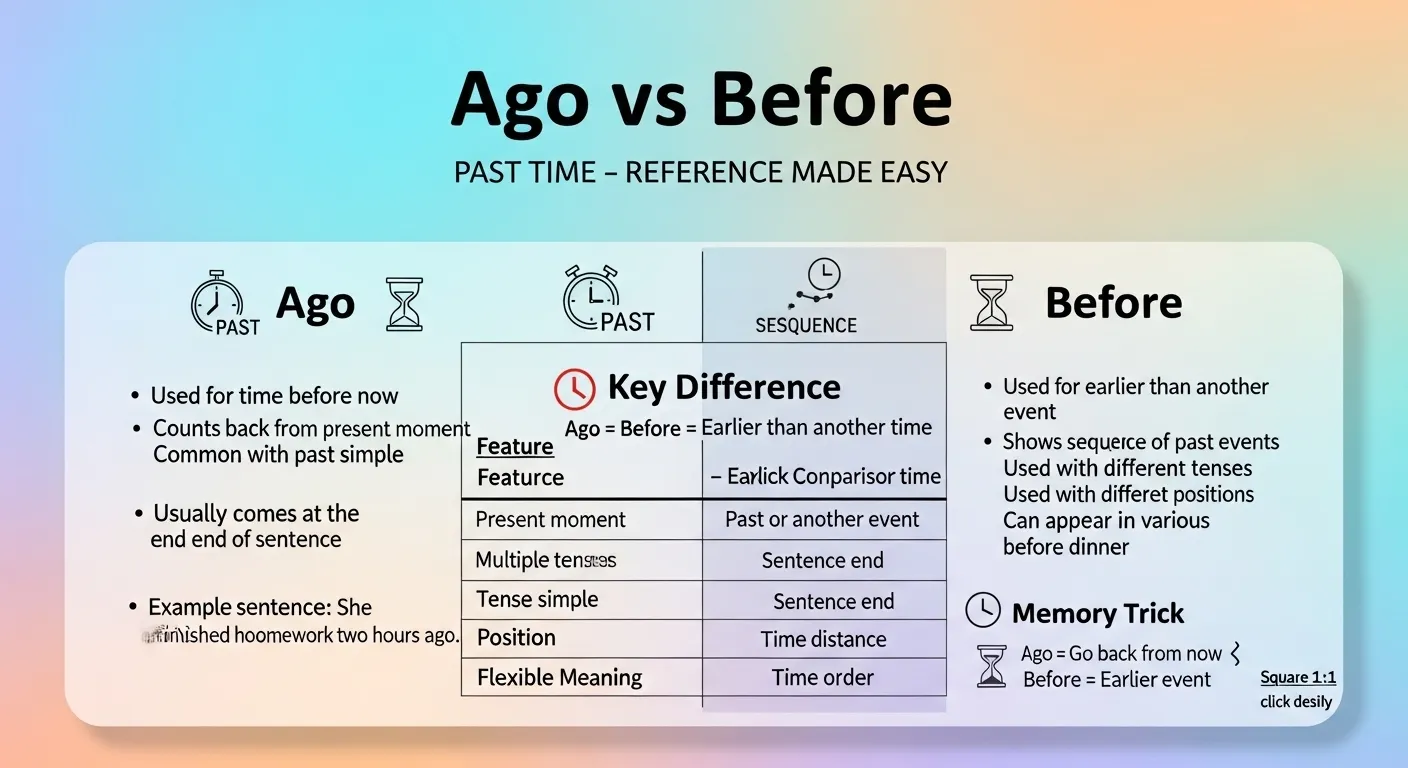
The difference between ago and before is simple. Ago is used to count back from the present moment, while before is used to talk about an earlier time from a past reference point. Imagine a student talking about an exam.
He says, “I finished the exam two hours ago.” This means the action happened two hours before now. Later, he says, “I had studied that topic before the exam.”
This means the action happened earlier than another past event. This situation explains the difference between ago and before clearly.
Many learners search questions like “ago vs before examples,” “when to use ago and before,” and “difference between ago and before in sentences.”
These questions show that the difference between ago and before is important in English grammar. Both words relate to past time, but they are used in different contexts.
Understanding the difference between ago and before helps learners express time correctly and avoid confusion.
Key Difference Between the Both
The main difference is reference point. Ago counts back from the present, while before refers to a time earlier than another event or moment.
Why Their Difference Is Necessary for Learners and Experts
Understanding this difference improves clarity in time expressions. Students use these words to describe past events correctly. Teachers rely on them to explain timelines in lessons.
In daily communication, people use ago to talk about recent past and before to compare past events. Using them correctly helps avoid confusion and ensures accurate communication in speaking and writing.
Pronunciation (US & UK)
| Term | US Pronunciation | UK Pronunciation |
| Ago | /əˈɡoʊ/ | /əˈɡəʊ/ |
| Before | /bɪˈfɔːr/ | /bɪˈfɔː/ |
Now that the basics are clear, let’s explore the detailed difference between ago and before.
Difference Between the Keywords
1. Time Reference
Ago refers to time before now. Before refers to time earlier than another event.
Example 1:
She left five minutes ago.
Example 2:
She had left before I arrived.
2. Use with Present
Ago is used with present or current reference. Before is not limited to present.
Example 1:
He called me an hour ago.
Example 2:
He had called me before dinner.
3. Sentence Structure
Ago is usually placed at the end of a sentence. Before can appear in different positions.
Example 1:
They met two years ago.
Example 2:
I have seen her before.
4. Use in Tenses
Ago is commonly used with past simple. Before can be used with various tenses.
Example 1:
We finished the work yesterday ago (incorrect).
Example 2:
We finished the work yesterday. (correct use with ago: “two days ago”)
5. Specific vs General Time
Ago gives a specific time distance. Before can be general or specific.
Example 1:
He arrived ten minutes ago.
Example 2:
I met him before.
6. Context of Use
Ago is used for exact time in the past. Before is used for sequence of events.
Example 1:
She graduated three years ago.
Example 2:
She had studied before the exam.
7. Question Form
Ago is used in questions about time from now. Before is used for past experience.
Example 1:
When did you arrive? I arrived an hour ago.
Example 2:
Have you seen this movie before?
8. Use in Negative Sentences
Before is common in negative sentences. Ago is less common.
Example 1:
He left a long time ago.
Example 2:
I have never visited that place before.
9. Use with Present Perfect
Ago is not used with present perfect. Before is often used.
Example 1:
I have seen him two days ago (incorrect).
Example 2:
I have seen him before (correct).
10. Focus of Meaning
Ago focuses on distance from now. Before focuses on earlier sequence.
Example 1:
They moved here five years ago.
Example 2:
They had lived elsewhere before.
Nature and Behaviour
Nature of Ago
Ago is fixed and simple. It always connects past time with the present moment.
Nature of Before
Before is flexible. It connects events in time and shows sequence.
Why People Are Confused About Their Use
Both words relate to past time. Learners often think they can be used in the same way. The confusion increases because both appear in past sentences, but their time reference is different.
Table Showing Difference and Similarity
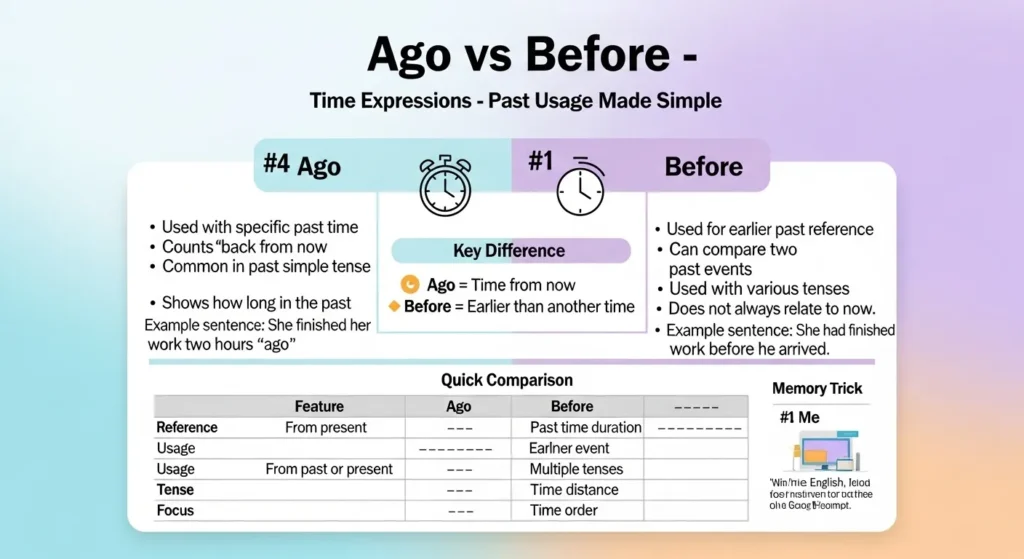
| Feature | Ago | Before | Similarity |
| Time reference | From present | From another time | Both refer to past |
| Usage | Fixed position | Flexible position | Both used in sentences |
| Tense | Past simple | Various tenses | Both show time |
| Meaning | Time distance | Earlier event | Both express past |
| Structure | Time + ago | Before + event | Both used in grammar |
Which Is Better in What Situation
When Ago Is Better
Ago is better when talking about how long ago something happened from the present moment. It is useful for giving exact time information, such as “two days ago” or “one year ago.”
When Before Is Better
Before is better when comparing two past events or talking about earlier experiences. It is useful in sentences like “I had finished my work before dinner” or “I have seen this movie before.”
How the Keywords Are Used in Metaphors and Similes
Ago metaphor:
Example: “Those memories feel like they happened ages ago.”
Before metaphor:
Example: “He had seen the storm before it arrived.”
Connotative Meaning
Ago neutral meaning
Example: “She left a week ago.”
Before neutral meaning
Example: “I met him before.”
Idioms or Proverbs Related to the Words
Long ago
Example: Long ago, people lived without modern technology.
As before
Example: Everything continued as before.
Works in Literature
- Long Ago and Far Away Memoir, W. Somerset Maugham, 1938
- Before We Were Strangers Novel, Renée Carlino, 2015
- Before the Fall Thriller, Noah Hawley, 2016
Movies Related to the Keywords
- Before Sunrise 1995, United States
- Before Sunset 2004, United States
- A Long Time Ago 1994, United States
Frequently Asked Questions
1. What is the difference between ago and before?
Ago refers to time before now, while before refers to earlier than another event.
2. Can ago be used with present perfect?
No. Ago is used with past simple tense.
3. Can before be used with present perfect?
Yes. It is commonly used with present perfect.
4. Where is ago placed in a sentence?
It usually comes at the end.
5. Why do learners confuse ago and before?
Because both refer to past time.
How Both Are Useful for Surroundings
Both words help people describe time clearly. Ago helps express how long ago something happened. Before helps show order and sequence of events.
Final Words for the Both
Ago and before are simple but important time expressions. Understanding their difference improves grammar and communication.
Conclusion
The difference between ago and before mainly depends on time reference. Ago connects past time with the present, while before connects events in relation to another time. Both are essential in English grammar and daily communication.
By understanding the difference between ago and before, learners can describe past events more clearly and accurately.
Discover More Articals!
Difference Between Synecdoche and Metonymy
Difference Between Say and Tell: Meaning And Examples(2026)

James Whitmore. Labdiff.com is my english grammar comparision website. I explore the history and evolution of English words. I write detailed comparisons explaining why spellings change over time and how British and American English diverged. My articles add depth and credibility to grammar comparison topics.