The difference between above and over is simple. Above means at a higher level without direct contact, while over often means covering, crossing, or being directly higher. Imagine a lamp hanging in a room.
It is above the table because it is at a higher position. Now imagine a blanket placed over the table. It covers the surface. This everyday example explains the difference between above and over clearly.
Many learners search questions like “above vs over examples,” “when to use above and over,” and “difference between above and over in sentences.”
These questions show that the difference between above and over is important in English. Both words describe position, but their meanings change depending on context.
Understanding the difference between above and over helps learners use correct prepositions and avoid confusion in speaking and writing.
Key Difference Between the Both
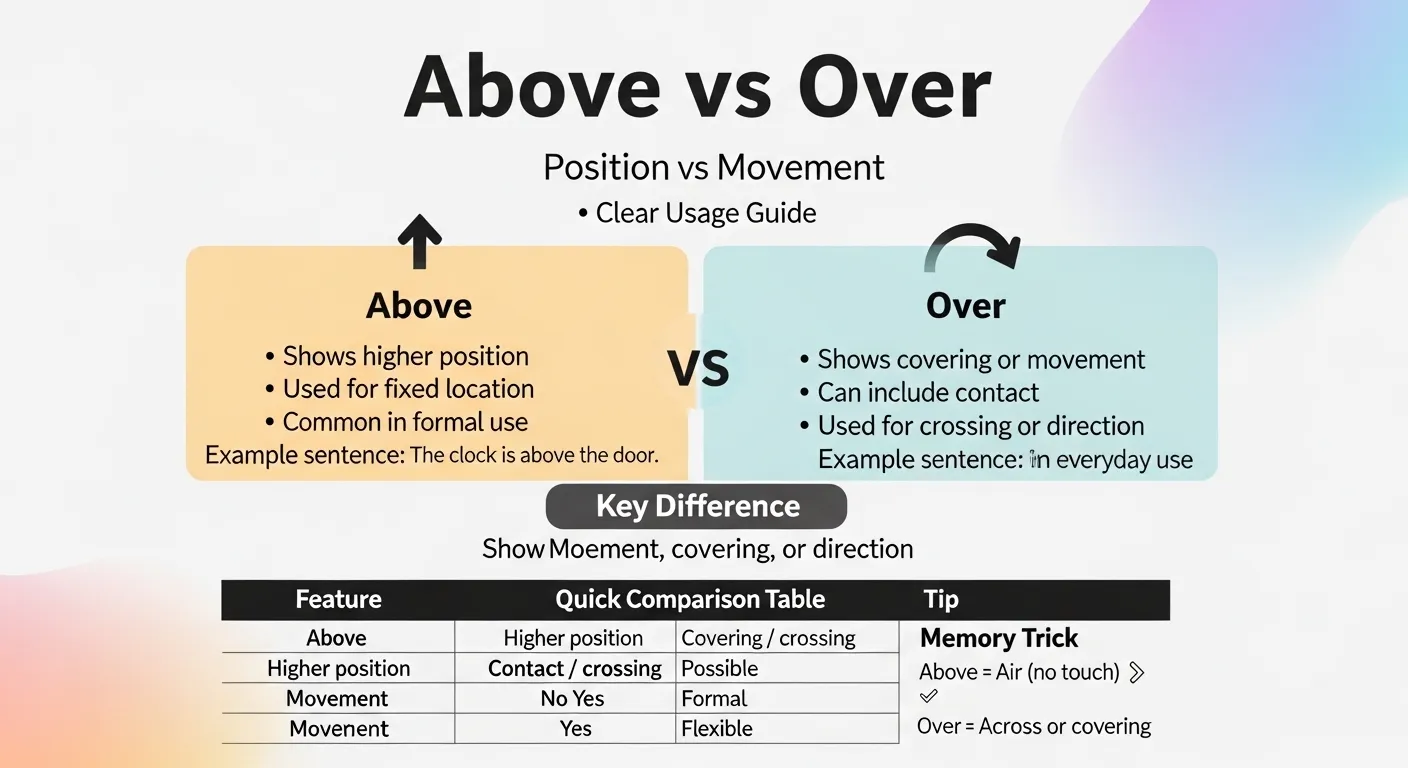
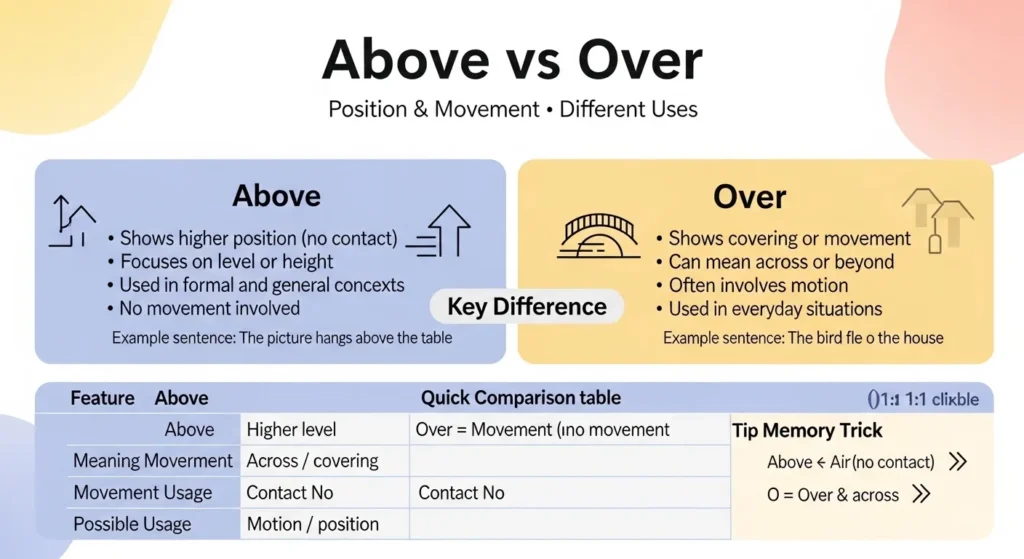
The main difference is position vs movement or coverage. Above shows a higher position, while over can show covering, movement, or directly higher position.
Why Their Difference Is Necessary for Learners and Experts
Understanding this difference improves accuracy in communication. Students use these prepositions in writing and speaking. Teachers explain them to show position and direction clearly.
In daily life, people use above to describe location and over to describe movement or covering. Using the correct word helps avoid misunderstandings and makes sentences clearer and more precise.
Pronunciation (US & UK)
| Term | US Pronunciation | UK Pronunciation |
| Above | /əˈbʌv/ | /əˈbʌv/ |
| Over | /ˈoʊvər/ | /ˈəʊvə/ |
Now that the basics are clear, let’s explore the detailed difference between above and over.
Difference Between the Keywords
1. Basic Meaning
Above means higher than something. Over can mean higher or covering something.
Example 1:
The clock is above the door.
Example 2:
The cloth is over the table.
2. Contact
Above shows no contact. Over can involve contact.
Example 1:
The bird flew above the trees.
Example 2:
He put a jacket over his shirt.
3. Movement
Over is used for movement from one side to another. Above is not.
Example 1:
The picture hangs above the sofa.
Example 2:
The cat jumped over the wall.
4. Coverage
Over is used when something covers another thing. Above does not show coverage.
Example 1:
The fan is above the bed.
Example 2:
She placed a blanket over the child.
5. Position
Above is used for fixed position. Over can be position or movement.
Example 1:
The light is above the table.
Example 2:
The plane flew over the city.
6. Use in Numbers
Above is used for higher numbers. Over is also used but less formal.
Example 1:
The temperature is above 30 degrees.
Example 2:
There were over 100 people at the event.
7. Use in Measurement
Above is used in formal measurement. Over is common in everyday speech.
Example 1:
The water level is above the mark.
Example 2:
He is over six feet tall.
8. Direction
Over often shows direction or crossing. Above does not.
Example 1:
The sign is above the door.
Example 2:
They walked over the bridge.
9. Usage in Expressions
Over is more common in idiomatic expressions.
Example 1:
The painting hangs above the fireplace.
Example 2:
The game is over.
10. Context of Use
Above is used in formal descriptions. Over is more flexible and common.
Example 1:
The value is above average.
Example 2:
He has control over the project.
Nature and Behaviour
Nature of Above
Above is static. It describes position without movement or contact.
Nature of Over
Over is dynamic. It describes position, movement, and coverage.
Why People Are Confused About Their Use
Both words can mean “higher than.” This similarity creates confusion. However, their difference appears when movement, contact, or coverage is involved.
Table Showing Difference and Similarity
| Feature | Above | Over | Similarity |
| Meaning | Higher position | Higher, covering, movement | Both show position |
| Contact | No contact | Can include contact | Both relate to location |
| Movement | No | Yes | Both used in sentences |
| Usage | Formal | Flexible | Both common in English |
| Context | Static position | Dynamic use | Both describe space |
Which Is Better in What Situation
When Above Is Better
Above is better when describing a fixed position at a higher level without contact. It is often used in formal writing and measurements. For example, “The temperature is above normal” clearly shows position without movement.
When Over Is Better
Over is better when describing movement, covering, or direction. It is useful in everyday speech and actions. For example, “The bird flew over the house” shows movement across space.
How the Keywords Are Used in Metaphors and Similes
Above metaphor:
Example: “She rose above the challenges.”
Over metaphor:
Example: “He has control over the situation.”
Connotative Meaning
Above positive meaning
Example: “She is above average in performance.”
Over neutral meaning
Example: “The meeting is over.”
Idioms or Proverbs Related to the Words
Above all
Example: Above all, honesty is important.
Over the moon
Example: She was over the moon after hearing the news.
Works in Literature
- Above the Bright Blue Sky Novel, Mona Simpson, 2010
- The Old Man and the Sea Fiction, Ernest Hemingway, 1952
- Over the Edge Thriller, Jonathan Kellerman, 1987
Movies Related to the Keywords
- Over the Hedge 2006, United States
- Above the Law 1988, United States
- Overboard 1987, United States
Frequently Asked Questions
1. What is the difference between above and over?
Above shows position, while over shows movement or covering.
2. Can both mean higher than?
Yes. Both can mean higher than in some contexts.
3. Which is more common in daily speech?
Over is more common in everyday use.
4. Can above show movement?
No. It is used for position only.
5. Why are they confusing?
Because both can describe something at a higher level.
How Both Are Useful for Surroundings
Both words help describe position, direction, and relationships in space. They are useful in giving directions, explaining locations, and describing movement.
Final Words for the Both
Above and over are simple but important prepositions. Understanding their difference improves clarity and accuracy in communication.
Conclusion
The difference between above and over lies in position, movement, and usage. Above describes a higher position without contact, while over describes covering, movement, or direction. Both words are important in English and are used in daily communication.
By understanding the difference between above and over, learners can use these prepositions correctly and express ideas more clearly.
Discover More Articals!
Difference Between Say and Tell: Meaning And Examples(2026)
Difference Between Ago and Before: Meaning and Correct Usage Guide(2026)

labdiff.com is my English grammar comparison website where I simplify confusing words, spelling differences, and usage rules through clear explanations and examples. My goal is to help learners, writers, and students understand English easily and use correct grammar with confidence.